 serverbastion.com

Dell PowerEdge R670 vs R660: The Best New 1U Server for Density
Buying guide · Updated 2026-09-17 · 7 min read
1U rack servers exist for one reason: putting the most compute in the least rack space. If you are standardizing a dense cluster, a hosting fleet, or a high-count virtualization farm, the R670 and R660 are Dell's current and previous-generation answers. Both are dual-socket, both support 8 TB of memory, and both are available from us brand-new and factory-sealed with a 3-year warranty.
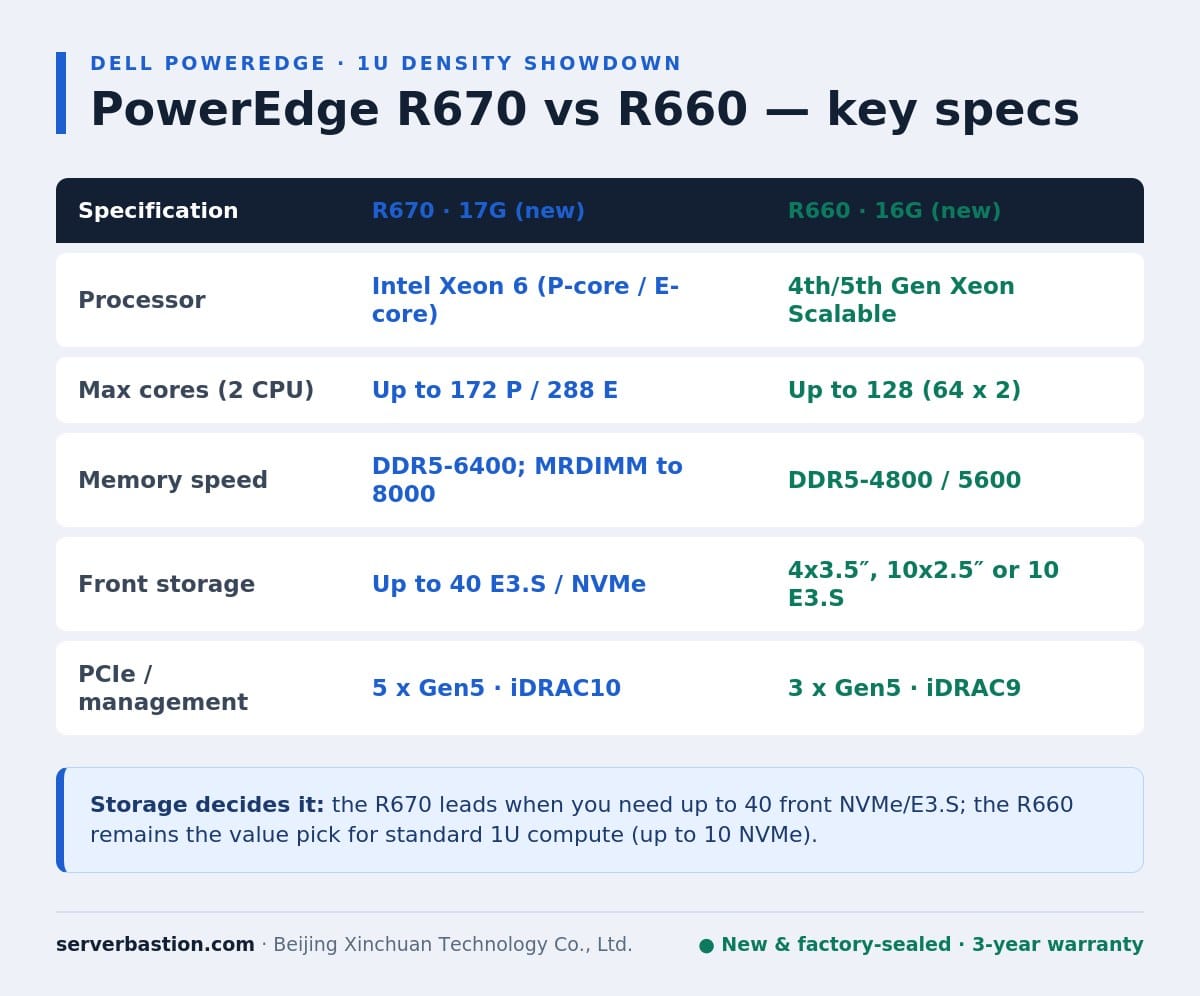
R670 vs R660 specification comparison
| Specification | PowerEdge R670 (17G, new) | PowerEdge R660 (16G, new) |
|---|---|---|
| Form factor | 1U dual-socket rack | 1U dual-socket rack |
| Processor family | Intel Xeon 6 (P-core / E-core) | 4th/5th Gen Intel Xeon Scalable |
| Max cores (2 CPUs) | Up to 172 P-cores; up to 288 E-cores | Up to 128 cores (64 × 2) |
| Memory slots | 32 DIMM slots | 32 DIMM slots |
| Memory type / speed | DDR5-6400; MRDIMM up to 8000 MT/s | DDR5-4800 / 5600 MT/s |
| Max memory | 8 TB | 8 TB |
| Front storage | Up to 40 front E3.S/NVMe drives | 4 × 3.5″, or 10 × 2.5″, or 10 × E3.S |
| Max NVMe drives | Up to 40 (E3.S/NVMe chassis) | Up to 10 NVMe |
| PCIe expansion | 5 × PCIe Gen5 (riser configs vary) | 3 × PCIe Gen5 |
| Internal GPUs | Limited / riser-dependent (1U) | Not designed for internal GPUs |
| Management | iDRAC10 | iDRAC9 |
| Condition / warranty | Brand-new, sealed, 3-year | Brand-new, sealed, 3-year |
Exact bay counts and riser options depend on the chassis and Dell's configuration matrix; we confirm every buildable SKU on the quote.
Why the R670 dominates on raw density
The 17G 1U platform benefits most from the new architecture. The E-core Intel Xeon 6 options push the dual-socket core count to up to 288, and the front storage chassis accepts up to 40 E3.S/NVMe drives — roughly four times the NVMe bay count of the R660. Add MRDIMM bandwidth, 5 Gen5 riser slots and iDRAC10, and the R670 is the clear choice when your goal is maximum nodes-per-rack for cloud-scale compute, dense container hosts, CDN/edge caching or all-flash hyper-converged infrastructure.
Why the R660 still makes sense
Many 1U deployments never approach 40 NVMe bays or 288 threads. For general virtualization, web and application tiers, network services, smaller databases and standard enterprise workloads, the R660 delivers:
- Up to 128 cores — plenty for a 1U enterprise host.
- The same 32 DIMM slots and 8 TB memory ceiling, on proven DDR5-4800/5600.
- Up to 10 direct NVMe drives — enough for most all-flash or hybrid nodes.
- PCIe Gen5 I/O, so it is not a previous-generation bus.
- A materially lower acquisition price as sealed channel stock.
If the workload fits, the R660 often produces the better cost-per-virtual-machine and cost-per-GB in the rack.
Storage: the real decision driver
More than cores, front-bay design should drive this choice. If the node needs very high local flash capacity — hyper-converged storage tiers, caching layers, content repositories — the R670's up-to-40 E3.S bay count is in a different class. If the server primarily boots locally and uses shared/NAS storage or a modest 4–10 NVMe configuration, the R660 chassis is sufficient and cheaper both to buy and, typically, to populate.
What about GPUs in 1U?
Neither 1U platform is a GPU server — 1U chassis cannot house double-wide accelerators with normal thermals. The R670 supports limited, riser-dependent accelerator options; the R660 is not designed for internal GPUs. If your workload needs double-wide GPU cards, step up to the 2U R770 or R760, which support up to two double-wide accelerators.
R670 vs R660: the buying rule
- Buy the R670 when core-per-rack, flash bays per node, memory bandwidth and longest lifecycle are the priorities — new greenfield platforms built for the next five years.
- Buy the R660 when a sealed, warrantied, PCIe Gen5 1U with up to 128 cores and 10 NVMe bays meets the spec and you would rather save the difference — especially across a large fleet.
Still deciding between 1U and 2U? Read the 2U R770 flagship and R760 pages, or start from the full Intel Xeon server range.
Get a quote on new PowerEdge servers
Tell us the CPU, memory, drive and quantity you need and we will come back with a firm channel price and lead time.
Or email info@sell-server.com. New units ship factory-sealed with a 3-year manufacturer warranty; sealed previous-generation stock is clearly identified as New Old Stock.
Frequently asked questions
What is the core-count difference between R670 and R660?
The 17G R670 scales to up to 172 performance cores, or up to 288 cores with E-core Intel Xeon 6 SKUs. The 16G R660 reaches a maximum of 128 cores (two 64-core processors). Both are dual-socket 1U servers.
How many NVMe drives does each 1U server support?
The R670 offers chassis with up to 40 front-loading E3.S/NVMe drives. The R660 supports front configurations of 4 × 3.5-inch, 10 × 2.5-inch, or 10 × E3.S, with up to 10 NVMe drives.
Can I put GPUs in an R670 or R660?
These are 1U servers and are not suitable for double-wide GPUs. The R670 allows only limited, riser-dependent accelerators, and the R660 is not designed for internal GPUs. For GPU workloads choose a 2U server such as the R770 or R760.
Are both new and do they carry a warranty?
Yes. We supply both the R670 and R660 brand-new and factory-sealed with a full 3-year manufacturer warranty.
Related servers
Specifications reflect official Dell PowerEdge technical documentation for the 17th-, 16th- and 15th-generation rack servers and our internal configuration database. Dell, PowerEdge and Xeon are trademarks of their respective owners and are used for identification only. Servers are sold and warranted by Beijing Xinchuan Technology Co., Ltd.. This article was last reviewed on 2026-09-17.

WeChat
Scan the QR Code with wechat