 serverbastion.com

Dell PowerEdge Generations Explained: 14G, 15G, 16G and 17G
Buying guide · Updated 2026-09-17 · 13 min read
If you are comparing individual models, start with our head-to-head guides for the R770 vs R760 (2U) and R670 vs R660 (1U). If you want the whole family on one page, this is it. You can also browse the full Intel Xeon PowerEdge range.
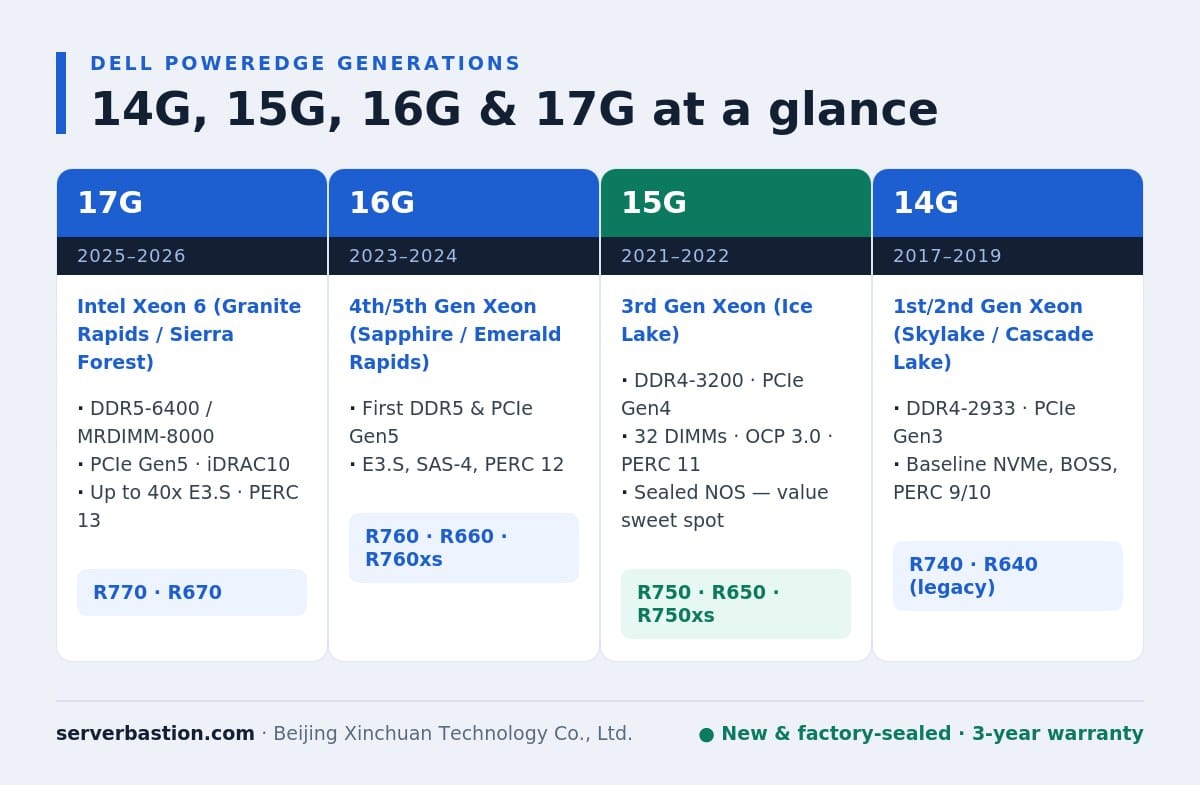
The four current PowerEdge generations at a glance
Each generation is a platform step: a newer CPU socket, a newer memory standard and a newer PCIe generation. The model number then tells you the form factor — an R7xx is 2U and an R6xx is 1U — while an xs suffix marks Dell's value / storage-streaming variant with a lower core and memory ceiling at a lower price.
| Gen | Years | CPU platform | Memory | PCIe | Management | Key change | Mainstream rack |
|---|---|---|---|---|---|---|---|
| 17G | 2025-2026 | Intel Xeon 6 (Granite Rapids / Sierra Forest) | DDR5-6400 / MRDIMM-8000 | PCIe Gen5 | iDRAC10 | P-core & E-core CPUs, MRDIMM, up to 40× E3.S, PERC 13 | R770, R670 |
| 16G | 2023-2024 | 4th/5th Gen Xeon Scalable (Sapphire Rapids / Emerald Rapids) | DDR5-4800/5600 | PCIe Gen5 | iDRAC9 | First DDR5 & PCIe Gen5, E3.S, SAS-4, PERC 12 | R760, R660, R760xs |
| 15G | 2021-2022 | 3rd Gen Xeon Scalable (Ice Lake) | DDR4-3200 | PCIe Gen4 | iDRAC9 | Up to 32 DIMMs, OCP 3.0, PMem 200, PERC 11 | R750, R650, R750xs (sealed NOS) |
| 14G | 2017-2019 | 1st/2nd Gen Xeon Scalable (Skylake-SP / Cascade Lake) | DDR4-2933 | PCIe Gen3 | iDRAC9 | Baseline NVMe support, BOSS, PERC 9/10 | R740, R640 (legacy, not stocked new) |
Platform details (years, CPU family, memory frequency, PCIe, management) are from Dell's official 14G-17G generation reference used for our internal configuration database.
17G (2025-2026): Intel Xeon 6, MRDIMM and iDRAC10
The newest generation moves PowerEdge from the legacy Xeon Scalable naming to Intel Xeon 6. That platform splits into P-core Granite Rapids parts for maximum per-socket performance and E-core Sierra Forest parts for very high core counts on throughput workloads. On the 2U PowerEdge R770 this reaches 86 performance cores per socket (172 in a dual-CPU system) or 144 efficiency cores per socket, while memory stays at 32 DIMMs and 8 TB but gains MRDIMM at 8000 MT/s for a large bandwidth gain over ordinary DDR5.
The 1U PowerEdge R670 shares the Xeon 6 platform and the 8 TB ceiling, and pushes E3.S NVMe density hard — up to 40 E3.S drives in a 1U chassis. Both models stay on PCIe Gen5 (the same I/O generation as 16G); the 17G step is about cores, memory bandwidth, E3.S capacity, the new iDRAC10 management controller and a longer support runway rather than a new PCIe generation.
- Best for: new deployments that need the highest core density or memory bandwidth, virtualization at scale, databases, AI-adjacent I/O-heavy builds, and buyers who want the newest supported platform.
- Condition we offer: brand-new, factory-sealed, 3-year manufacturer warranty.
16G (2023-2024): first DDR5 and PCIe Gen5
The 16th generation introduced DDR5 and PCIe Gen5 to mainstream rack servers, using 4th and 5th Gen Intel Xeon Scalable (Sapphire Rapids and Emerald Rapids). The 2U PowerEdge R760 reaches 128 cores (64×2) and 8 TB of DDR5-4800/5600 with CXL 1.1 memory expansion, up to 24 NVMe drives, eight Gen5 slots and two double-width GPUs. Because it shares the Gen5 I/O and DDR5 memory of 17G but sits one platform step behind, it is usually the best price/performance choice for GPU, storage and general enterprise builds.
The 1U PowerEdge R660 offers the same 128 cores and 8 TB in a denser chassis with three Gen5 slots and up to ten NVMe / E3.S drives. For budget and storage-density use cases, the PowerEdge R760xs keeps DDR5 and Gen5 but caps at 64 cores, 16 DIMMs, 2 TB and eight NVMe drives — the same role the xs line plays in every generation.
- Best for: buyers who want DDR5 and PCIe Gen5 without paying the newest-platform premium, and most general virtualization, VDI, database and GPU workloads.
- Condition we offer: brand-new, factory-sealed, 3-year manufacturer warranty.
What you actually gain when you step up a generation
The raw spec tables only tell part of the story; in practice each step changes what a rack can do. Moving from 15G to 16G swaps DDR4 for DDR5 and Gen4 for Gen5, which matters most for high-frequency trading, dense NVMe storage and current-generation networking and accelerators; it also keeps you on a platform whose firmware, NIC and GPU certifications are actively updated. Moving from 16G to 17G keeps Gen5 but adds the Xeon 6 core and bandwidth step — more cores per socket, MRDIMM at 8000 MT/s, and the efficiency-core path for workloads such as web serving, CDN, containers and cold storage that want throughput more than peak single-thread speed.
Conversely, the step from 14G to 15G is where the mainstream memory ceiling rose from 3 TB to 8 TB, DIMM slots rose from 24 to 32 on the full-size models, and PCIe moved to Gen4. That is why a sealed R750 or R650 is a sensible budget anchor in 2026 but an R740 bought new is not: the 15G machine still runs current hypervisors and databases with headroom and ships with a real 3-year warranty, while the 14G platform is effectively in its end-of-life tail.
If your workload already runs comfortably on the target core count, memory and NIC generation, the “best” generation is the one that matches those requirements at the lowest capital cost — which is often sealed 15G NOS rather than the newest 17G. Our team can size this with you against an actual BOM instead of pushing the latest model; send us your configuration for a recommendation.
15G (2021-2022): the value sweet spot as sealed NOS
The 15th generation is built on 3rd Gen Intel Xeon Scalable (Ice Lake) with DDR4-3200 and PCIe Gen4. It is still a thoroughly capable platform: the 2U PowerEdge R750 reaches 80 cores and 8 TB of memory, supports up to 24 NVMe drives and eight Gen4 slots, and takes two double-width GPUs. The 1U PowerEdge R650 offers the same 80 cores and 8 TB in 1U with up to ten NVMe drives. The PowerEdge R750xs is the value variant at up to 64 cores, 16 DIMMs and 1 TB.
We offer 15G as factory-sealed New Old Stock (NOS), not as used servers: never-deployed, original-box units from channel inventory. If you are new to the term, read our explanation of what New Old Stock means and how it differs from current-generation new. Crucially, every sealed NOS server we sell carries a full 3-year replacement warranty directly backed by Beijing Xinchuan Technology Co., Ltd., so your coverage does not depend on the unit's build date.
- Best for: cost-conscious virtualization, storage and general compute where DDR5/Gen5 is not required, and buyers who want brand-new hardware at a previous-generation price.
- Condition we offer: sealed NOS, 3-year warranty backed by us.
14G (2017-2019): legacy platform, not our starting point
The 14th generation (R740 2U, R640 1U) uses 1st/2nd Gen Xeon Scalable, DDR4-2933 and PCIe Gen3, topping out at 56 cores, 3 TB of memory and 12 NVMe drives. It was a widely deployed generation, but it is now a legacy platform with a shorter support runway. We do not carry 14G as a new line. If you are evaluating something at the R740 / R640 tier — for example to replace an aging fleet on a budget — a sealed 15G R750 or R650 gives you two more PCIe and memory generations, double the memory ceiling and a fresh 3-year warranty for a modest step up in price. See how that gap looks in practice in our generation comparison notes.
2U rack server model table (R7xx)
| 2U model | CPU / max cores | Memory | Front storage / NVMe | PCIe slots | GPU / role | PSU |
|---|---|---|---|---|---|---|
| R770 (17G) | Xeon 6, up to 86 P-cores×2 (172 total) / 144 E-cores×2 | 32× DDR5, up to 8 TB (RDIMM-6400 / MRDIMM-8000) | 8×3.5 / 24×2.5 / 40× E3.S · up to 44 NVMe | 8× Gen5 | 2× double-width GPUs (450W) | 1100/1500/2400/3200W |
| R760 (16G) | 4th/5th Gen Xeon, up to 64 cores×2 (128 total) | 32× DDR5-4800/5600, up to 8 TB + CXL 1.1 | 8/12×3.5 or 24×2.5 · up to 24 NVMe | 8× Gen5 | 2× double-width GPUs (350W) | 800/1400/2400/2800W |
| R760xs (16G) | 4th Gen Xeon, up to 32 cores×2 (64 total) | 16× DDR5-4800, up to 2 TB | 8/12×3.5 or 24×2.5 · up to 8 NVMe | 5× Gen5 | Value/streaming-optimized | 800/1400/1800W |
| R750 (15G NOS) | 3rd Gen Xeon (Ice Lake), up to 40 cores×2 (80 total) | 32× DDR4-3200, up to 8 TB | 8/12×3.5 or 24×2.5 · up to 24 NVMe | 8× Gen4 | 2× double-width GPUs (300W) | 800/1400/2400/2800W |
| R750xs (15G NOS) | 3rd Gen Xeon, up to 32 cores×2 (64 total) | 16× DDR4-3200, up to 1 TB | 8/12×3.5 or 24×2.5 (no native NVMe backplane) | 5× Gen4 | Value/streaming-optimized | 800/1100/1400W |
| R740 (14G, legacy) | 1st/2nd Gen Xeon, up to 28 cores×2 (56 total) | 24× DDR4-2933, up to 3 TB | 8×3.5 or 16×2.5 · up to 12 NVMe | 8× Gen3 | 3× double-width GPUs (300W) | 750/1100/1600/2400W |
R770 and R760 also have dedicated accelerator chassis (R770xa / R760xa) for larger GPU builds; the figures above are the mainstream rack models we quote and stock. Model figures are from official Dell PowerEdge technical specifications.
1U rack server model table (R6xx)
| 1U model | CPU / max cores | Memory | Front storage / NVMe | PCIe slots | PSU |
|---|---|---|---|---|---|
| R670 (17G) | Xeon 6, up to 86 P-cores×2 / 144 E-cores×2 | 32× DDR5, up to 8 TB (MRDIMM-8000) | 4×3.5 / 10× E3.S / 40× E3.S · up to 40 NVMe | 5× Gen5 | 1100/1500/2400W |
| R660 (16G) | 4th/5th Gen Xeon, up to 64 cores×2 (128 total) | 32× DDR5-4800/5600, up to 8 TB + CXL 1.1 | 4×3.5 / 10×2.5 / 10× E3.S · up to 10 NVMe | 3× Gen5 | 800/1400/1800/2400W |
| R650 (15G NOS) | 3rd Gen Xeon (Ice Lake), up to 40 cores×2 (80 total) | 32× DDR4-3200, up to 8 TB | 4×3.5 or 10×2.5 · up to 10 NVMe | 3× Gen4 | 800/1400/1800/2400W |
| R640 (14G, legacy) | 1st/2nd Gen Xeon, up to 28 cores×2 (56 total) | 24× DDR4-2933, up to 3 TB | 4×3.5 or 10×2.5 · up to 10 NVMe | 3× Gen3 | 750/1100/1600W |
How to choose a generation in one pass
- Want the newest and longest-supported platform, maximum cores or MRDIMM bandwidth? Go 17G — R770 in 2U or R670 in 1U.
- Want DDR5 and PCIe Gen5 at the sharpest price? Go 16G — R760 / R660, or the R760xs for a value build.
- Want new, sealed hardware at the lowest capital cost? Go sealed 15G NOS — R750 / R650 / R750xs, each with our 3-year backed warranty.
- Looking at 14G R740/R640 pricing? Pivot to a sealed R750/R650 for a newer platform and a real warranty instead of buying legacy hardware new.
Wondering whether to buy through a channel partner or configure direct with Dell? Our channel vs Dell direct walkthrough covers pricing, lead times and warranty. For the warranty terms behind each condition tier, see our full warranty policy overview or read why customers why customers buy PowerEdge from us.
Frequently asked questions
What are the Dell PowerEdge generations?
PowerEdge rack servers are grouped into generations. The four most recent are 14G (2017-2019, 1st/2nd Gen Intel Xeon Scalable, DDR4, PCIe Gen3), 15G (2021-2022, 3rd Gen Xeon Scalable Ice Lake, DDR4-3200, PCIe Gen4), 16G (2023-2024, 4th/5th Gen Xeon Scalable, DDR5, PCIe Gen5, E3.S) and 17G (2025-2026, Intel Xeon 6 with P-cores and E-cores, DDR5-6400 / MRDIMM-8000, iDRAC10).
What is the newest PowerEdge generation?
The 17th generation (17G) is the newest, launched from 2025. Its mainstream Intel rack servers are the 2U PowerEdge R770 and 1U PowerEdge R670, built on Intel Xeon 6 (Granite Rapids P-cores up to 86 per socket, plus Sierra Forest E-core options), with up to 8 TB of DDR5 (MRDIMM at 8000 MT/s on the R770), PCIe Gen5 and E3.S NVMe storage.
Is 15G PowerEdge still worth buying in 2026?
Yes, when it is brand-new, factory-sealed New Old Stock rather than a used machine. The 15G R750 and R650 still deliver up to 80 cores and 8 TB of DDR4, PCIe Gen4 and 24 NVMe drives in the 2U R750, which covers most virtualization, database and general workloads. Sealed NOS costs materially less than 16G/17G and every NOS unit we sell carries a full 3-year warranty directly backed by Beijing Xinchuan Technology Co., Ltd.
What is the difference between 16G and 17G PowerEdge?
16G (R760/R660) uses 4th/5th Gen Xeon Scalable (Sapphire Rapids / Emerald Rapids), DDR5-4800/5600 and PCIe Gen5, topping out at 128 cores. 17G (R770/R670) moves to Intel Xeon 6, adds MRDIMM memory at up to 8000 MT/s, raises the 2U peak to 172 performance cores (288 with E-cores), widens NVMe/E3.S capacity and introduces iDRAC10. Both are PCIe Gen5; the 17G jump is mainly in cores, memory bandwidth and platform lifecycle.
Which PowerEdge generation should I buy: 15G, 16G or 17G?
Buy 17G (R770/R670) for maximum cores, memory bandwidth and the longest support runway; buy 16G (R760/R660) for PCIe Gen5 and DDR5 at the best price/performance; buy sealed 15G NOS (R750/R650) when you want dependable performance at the lowest capital outlay. 14G (R740/R640) is a legacy platform we no longer carry new; if you are considering a 14G-class build, a sealed R750/R650 is the better-supported starting point.
Do newer generations support more memory?
Yes. 14G maxed at 3 TB of DDR4-2933 on the R740/R640. 15G lifted the mainstream R750/R650 to 8 TB of DDR4-3200. 16G kept an 8 TB ceiling but moved to DDR5-4800/5600 with CXL memory expansion, and 17G holds 8 TB while adding MRDIMM at 8000 MT/s for substantially higher memory bandwidth. The value-oriented xs models cap lower (1 TB on R750xs, 2 TB on R760xs).
Does the warranty differ by generation?
Brand-new current and previous-generation servers (17G and 16G) ship with a 3-year manufacturer warranty. Sealed 15G New Old Stock carries a full 3-year replacement warranty backed directly by Beijing Xinchuan Technology Co., Ltd., so coverage does not depend on the original build date.
R670 vs R660: new 1U density17G vs 16G in 1U
All Intel Xeon PowerEdge serversR770, R670, R760, R660, R750, R650
Request a quoteFirm channel price and lead time
Get a quote on new PowerEdge servers
Tell us your target generation or model, CPU, memory, storage and quantity. We will recommend the right R7xx/R6xx build, confirm whether it ships as current stock or sealed NOS, and quote a firm channel price.
Or email info@sell-server.com. New units ship factory-sealed with a 3-year manufacturer warranty; sealed previous-generation stock is clearly identified as New Old Stock.
Specifications reflect official Dell PowerEdge technical documentation for the 17th-, 16th- and 15th-generation rack servers and our internal configuration database. Dell, PowerEdge and Xeon are trademarks of their respective owners and are used for identification only. Servers are sold and warranted by Beijing Xinchuan Technology Co., Ltd.. This article was last reviewed on 2026-09-17.

WeChat
Scan the QR Code with wechat