 serverbastion.com

R7715 Single-Socket EPYC: What One 17G Turin Socket Delivers in 2U
Buying guide · Updated 2026-09-19 · 9 min read
Short answer: is one EPYC socket enough in 2026?
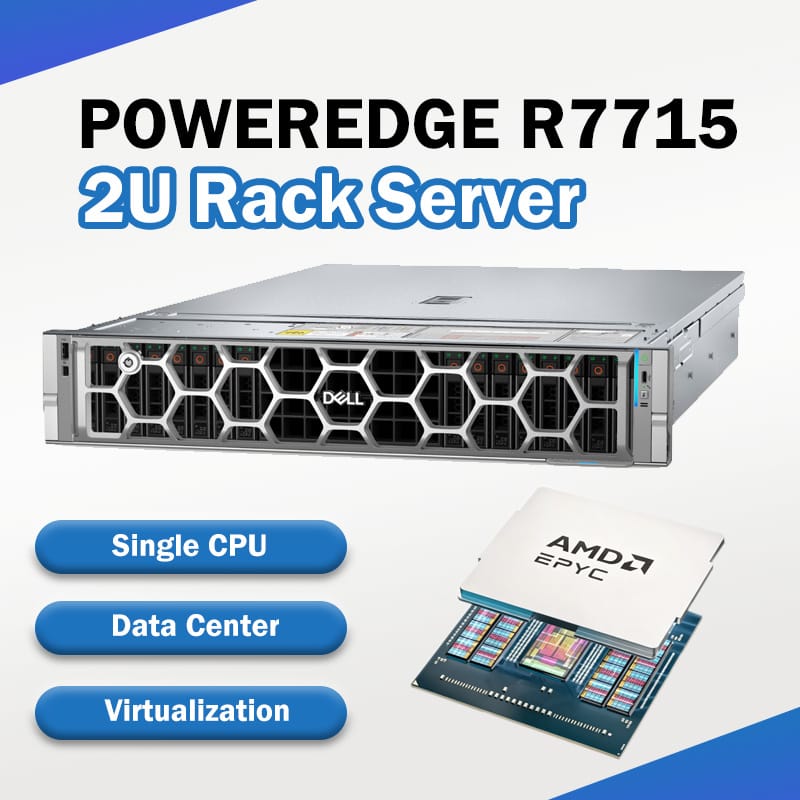
For most workloads, yes — and the R7715 is the flagship 2U way to do it. One Turin socket covers the cores, memory and I/O that most virtualization hosts, per-core-licensed databases, all-flash storage nodes and VDI or inference boxes consume, while removing an entire processor from your licensing, power and cooling math.
Keep a dual-socket R7725 or R6725 in reserve for the exceptions: more than 160 cores in one system, maximum DDR5-6400 memory bandwidth, or the densest possible 1U. If your two-socket hosts run with one socket effectively idle, you are licensing and cooling silicon you do not need.
How one EPYC socket grew from 32 to 160 cores
Every EPYC generation widened what a single package could hold, and Dell’s single-socket PowerEdge family tracked it step for step:
| Platform | EPYC family | Cores per socket | Memory & I/O | Dell 1U / 2U |
|---|---|---|---|---|
| 14G | EPYC 7001 Naples | Up to 32 | DDR4-2666, PCIe Gen3 | R6415 / R7415 |
| 15G | EPYC 7002 Rome / 7003 Milan | Up to 64 | DDR4-3200, PCIe Gen4 | R6515 / R7515 |
| 16G | EPYC 9004 Genoa | Up to 128 | DDR5-4800, PCIe Gen5, E3.S | R6615 / R7615 |
| 17G | EPYC 9005 Turin | Up to 160 | DDR5-5200, PCIe Gen5, E3.S | R6715 / R7715 |
A single 2026 socket in the R7715 offers five times the cores of a first-generation R7415, with faster memory and two PCIe generations newer — one current socket can match or beat a two-socket fleet only a few refresh cycles old. The 2U R7515 remains available factory-sealed as New Old Stock (NOS), covered in our NOS server guide, but the value center of a new purchase has moved to 17G. Retired model numbers in the table are reference only; see the Dell AMD EPYC model list for the current lineup.
Why a single socket lowers your real cost
The hardware saving is the easy part. The bigger lever is software and data-center cost over a four- or five-year platform life:
- Per-core database licensing. Microsoft SQL Server and Oracle Database are licensed by physical core: one 160-core socket means you never license a second processor or its idle headroom, and per-socket products see the socket count cut in half.
- Windows Server, VDI and hypervisor billing. Some Windows Server scenarios, VDI suites and per-core hypervisor pricing shrink in lockstep with the cores and sockets you deploy.
- Power and cooling. One package, one thermal zone, often a lower PSU tier — the per-rack kilowatts add up across dozens of hosts.
- Simpler operations. One NUMA domain with no cross-socket fabric to size, one socket to count at license audits, one BIOS and firmware baseline, and simpler DIMM sizing.
This is not an argument for the smallest system — buy the fewest licensed cores that meet your peak, and at 160 cores one socket covers a great deal.
What the R7715 delivers in a 2U chassis
The single-socket enclosure stopped being a compromise: Dell’s published R7715 specifications read like a two-socket data sheet.
- Processor: 1 × AMD EPYC 9005 Series (Turin / Turin-Dense, Zen 5), SP5, up to 160 cores.
- Memory: 24 × DDR5 RDIMM at 5200 MT/s across 12 channels, up to 6 TB.
- Front storage: 12 × 3.5-inch; 8 × 2.5-inch universal; 16 or 24 × 2.5-inch; 16 × 2.5-inch SSD plus 8 × U.2; or 8/16/32/40 × E3.S (plus 2 × U.2) — up to 40 × E3.S Gen5 NVMe. No rear bays.
- Accelerators: up to 3 × double-width GPUs in the up to 450 W class, or up to 6 × 75 W single-width cards.
- Expansion and networking: up to 8 × PCIe Gen5 x16 slots plus 2 × OCP 3.0; dual 1GbE LOM, or high-speed OCP/PCIe networking.
- Storage controllers and boot: PERC H365i, H965i or H975i; external HBA465e; BOSS-N1 redundant boot.
- Power, cooling, management: PSUs up to 3200 W, Multi-Vector Cooling 2.0, and iDRAC10.
- Condition and warranty: brand-new 17G platform with a 3-year manufacturer warranty.
The full single-socket lineup and how the generations compare lives in our single-socket EPYC guide.
Workloads that fit one socket
- Virtualization and private cloud. VMware vSphere, Hyper-V and Proxmox/KVM consolidation hosts land well inside 160 cores and 6 TB, with one NUMA domain for simpler VM placement.
- Per-core-licensed databases. SQL Server and Oracle systems are the clearest financial case: throughput from one socket, with licensing tied to physical cores rather than server count.
- Software-defined and all-flash storage. Up to 40 E3.S Gen5 drives makes the R7715 a dense node for vSAN, HCI and other software-defined storage designs.
- VDI and inference. Three double-width 450 W-class accelerators (or six 75 W cards) cover virtual desktop farms and modest AI inference and serving builds.
- Edge and single-node deployments. One CPU ecosystem means simpler spares, one thermal profile and iDRAC10-managed lifecycle at remote sites.
When you still want two sockets
Single socket is the value default, not the universal answer. Move to a dual-socket 17G build in three situations:
- You genuinely need more than 160 cores in one system. The 2U R7725 scales to 192 cores per socket — 384 cores total — and the 1U R6725 reaches the same 384-core ceiling.
- Your bottleneck is memory bandwidth. Dual Turin platforms run 24 channels of DDR5-6400 (up to 6 TB) for the largest in-memory databases; the R7715 provides 12 channels at DDR5-5200.
- You need the densest 1U footprint with maximum cores and 6 TB in one rack unit — that is the R6725’s territory.
One inversion: with up to three double-width GPU slots, the 2U R7715 is not penalized on accelerators, so GPUs alone are no reason to go dual.
1U or 2U: choosing within the single-socket family
The two current single-socket Turin servers split by density rather than generation:
- R6715 (1U). Same up-to-160-core Turin ceiling, with up to 22 E3.S drives (20 front plus 2 rear), but up to 3 TB of memory and 75 W single-width accelerators only. Pick it for rack-density compute and NVMe with modest acceleration.
- R7715 (2U). Up to 6 TB, up to 40 E3.S, and three double-width 450 W-class GPUs. Pick it for storage density, memory capacity and accelerator headroom.
If a prior-generation platform fits, the 16G R7615 (2U, up to 128 cores, 32 E3.S) and R6615 (1U) remain capable Genoa designs, alongside the 15G R6515 and the original R6415/R7415; find them in the AMD EPYC model list. The sealed NOS R7515 is the value 2U pick when 64 cores suffice. For the full family, see the AMD EPYC servers hub.
How we supply and warranty the R7715
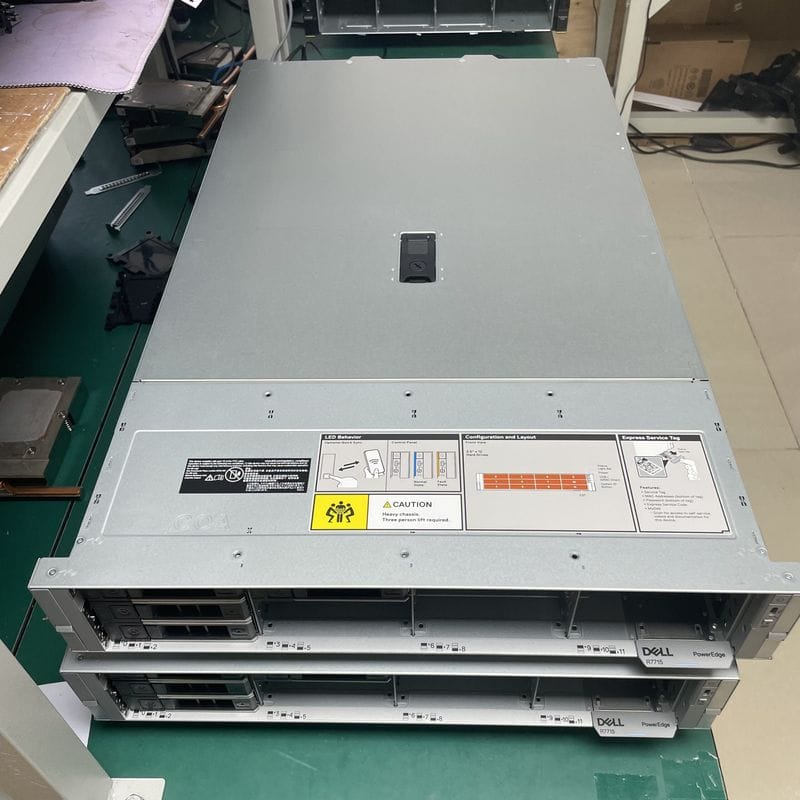
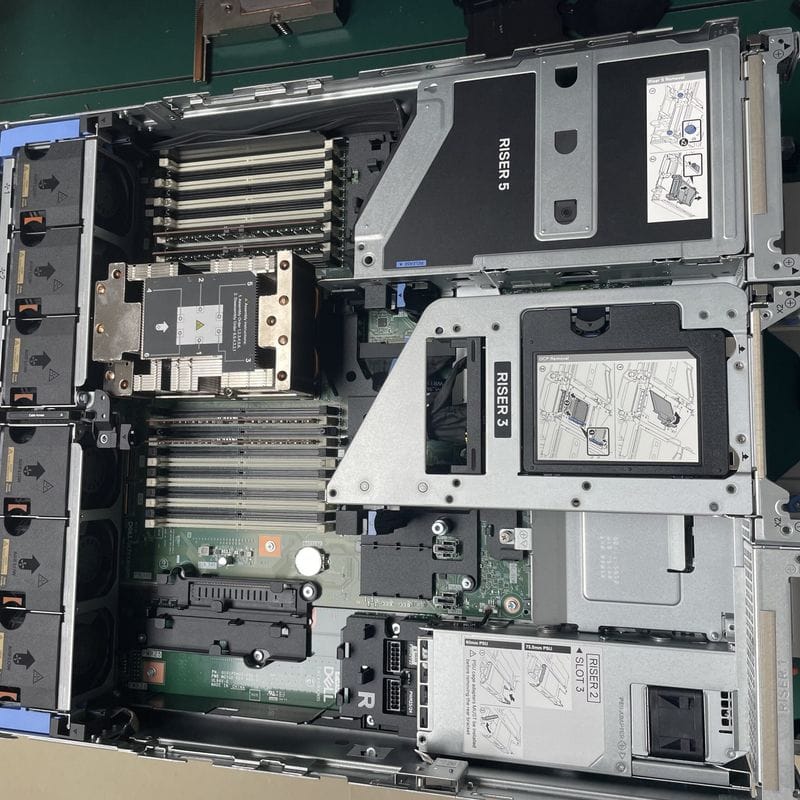
Beijing Xinchuan Technology Co., Ltd. supplies the R7715 brand-new and factory-sealed as a current 17G model with the 3-year manufacturer warranty (see our warranty page). Every unit is built to your exact CPU SKU, DIMM map, RAID controller and backplane, receives a pinned BIOS and firmware baseline, and completes a stress test before export; batches are matched and palletized for international shipment. The photographs show a real R7715 in our configuration and test area.
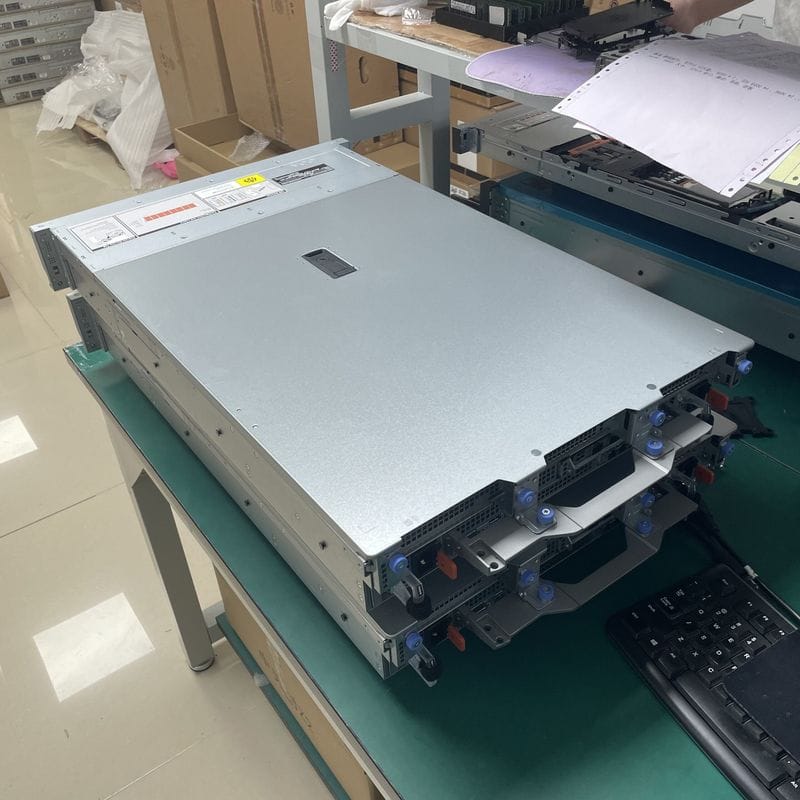
Because chassis, riser, PSU and backplane rules interact, we quote a validated bill of materials against your configuration instead of a generic list price.
Single-socket EPYC guide Generations, licensing logic and workloads
AMD EPYC servers hub The current PowerEdge AMD range
Complete AMD EPYC model list All current Dell AMD models in one place
Configure your single-socket R7715
Send your target CPU SKU, memory, drive layout and accelerators — or just the workload and VM or user counts. We will validate the build and quote a new sealed unit with the 3-year warranty.
Or email info@sell-server.com with your specification.
Frequently asked questions
Is the PowerEdge R7715 single-socket or dual-socket?
The R7715 is a single-socket server: it holds exactly one AMD EPYC 9005 Series (Turin or Turin-Dense, Zen 5) processor in an SP5 package, scaling to 160 cores in a 2U chassis. If you need two CPUs and up to 384 cores, the dual-socket 17G alternatives are the R7725 (2U) and R6725 (1U).
How many cores does one EPYC 9005 socket provide?
A single EPYC 9005 Turin socket scales up to 160 cores in Dell 17G single-socket servers such as the R7715 (2U) and R6715 (1U). One modern socket now matches the core count of an older dual-socket fleet; a current dual-socket 17G build reaches up to 192 cores per socket and 384 cores in total.
Does single-socket really lower SQL Server, Oracle and Windows licensing?
Yes, for software licensed by physical core. Microsoft SQL Server and Oracle Database charge per physical core, so consolidating onto one 160-core socket means you never license a second CPU or its idle headroom. Products billed per socket, and some Windows Server, VDI and hypervisor billing models, benefit the same way. Verify current entitlement rules with your software vendor.
What are the R7715 maximum memory and storage figures?
The R7715 has 24 DDR5 RDIMM slots across 12 memory channels at 5200 MT/s, for up to 6 TB total. Front storage scales to 40 E3.S Gen5 NVMe drives (plus 2 x U.2 in that build), with alternatives including 12 x 3.5-inch, 8 x 2.5-inch universal, 16 or 24 x 2.5-inch, or 16 x 2.5-inch SSD plus 8 x U.2. There are no rear bays.
Can the R7715 take GPUs?
Yes. The 2U R7715 supports up to three double-width accelerators in the up to 450 W class, or up to six 75 W single-width cards, backed by PSUs up to 3200 W and up to eight PCIe Gen5 x16 slots. That covers inference, VDI and modest AI-adjacent builds. The 1U R6715 accepts 75 W single-width cards only.
When should I choose single-socket over dual-socket EPYC?
Choose one socket for most virtualization, per-core-licensed database, all-flash storage, VDI and inference workloads up to 160 cores and 6 TB. Move to a dual-socket R7725 or R6725 when a single system needs more than 160 cores (up to 384), 24-channel DDR5-6400 bandwidth, or the densest 1U footprint. One socket is the value default; two sockets remain the scale-out exception.
Is the R7715 sold new, what is the warranty, and how do I order?
The R7715 is supplied brand-new and factory-sealed as a current 17G model with a 3-year manufacturer warranty. Each unit is built to your exact CPU SKU, DIMM map, RAID controller and drive backplane, receives a BIOS and firmware baseline plus a stress test before shipment, and is quoted per configuration through Request a Quote, WhatsApp or email.
Trademarks appear solely for product identification. Specifications reflect Dell published figures at the time of writing and vary by chassis and riser configuration. Last reviewed 2026-09-19.

WeChat
Scan the QR Code with wechat