 serverbastion.com

Dell PowerEdge R750 NOS vs R760 New: Pay Less for DDR4 or Move to DDR5?
Buying guide · Updated 2026-09-19 · 9 min read
Short answer: which should you buy?
Choose the factory-sealed R750 NOS when your workload fits within 80 cores and DDR4, you standardize on DDR4-3200 memory and Gen4 adapters, and acquisition cost matters more than the longest platform runway. Choose the brand-new R760 for new multi-year projects needing up to 128 cores, DDR5 bandwidth, PCIe Gen5, CXL 1.1 and the longest support life. Both arrive factory-sealed with a 3-year warranty.
| If your priority is… | Choose |
|---|---|
| Up to 128 cores on the newest 4th/5th-Gen Xeon Scalable | R760 (16G, new) |
| DDR5-4800/5600 memory and CXL 1.1 expansion | R760 (16G, new) |
| PCIe Gen5 slots and 350 W double-width GPUs | R760 (16G, new) |
| Longest remaining support runway for a 2026 build | R760 (16G, new) |
| Mainstream workloads within 80 cores, friendlier acquisition cost | R750 (15G, NOS) |
| Existing DDR4-3200 memory and Gen4 adapter spares | R750 (15G, NOS) |
| A mature, immediately available sealed-new 2U platform | R750 (15G, NOS) |
First, what “NOS” means on the R750
Every R750 we offer in this program is new old stock (NOS): an original Dell-built system that left the factory sealed, was never powered on or deployed, and has been held as sealed inventory. It is not a decommissioned data-center machine, a returned unit or a remanufactured one. The only thing “old” is the platform generation — 15G with 3rd-Gen Intel Xeon Scalable. More on our what is new old stock page.
Because the hardware is factory-fresh, each R750 NOS ships with a 3-year warranty, the same term as current-production servers. Full terms are on the warranty page.
Where the two servers sit
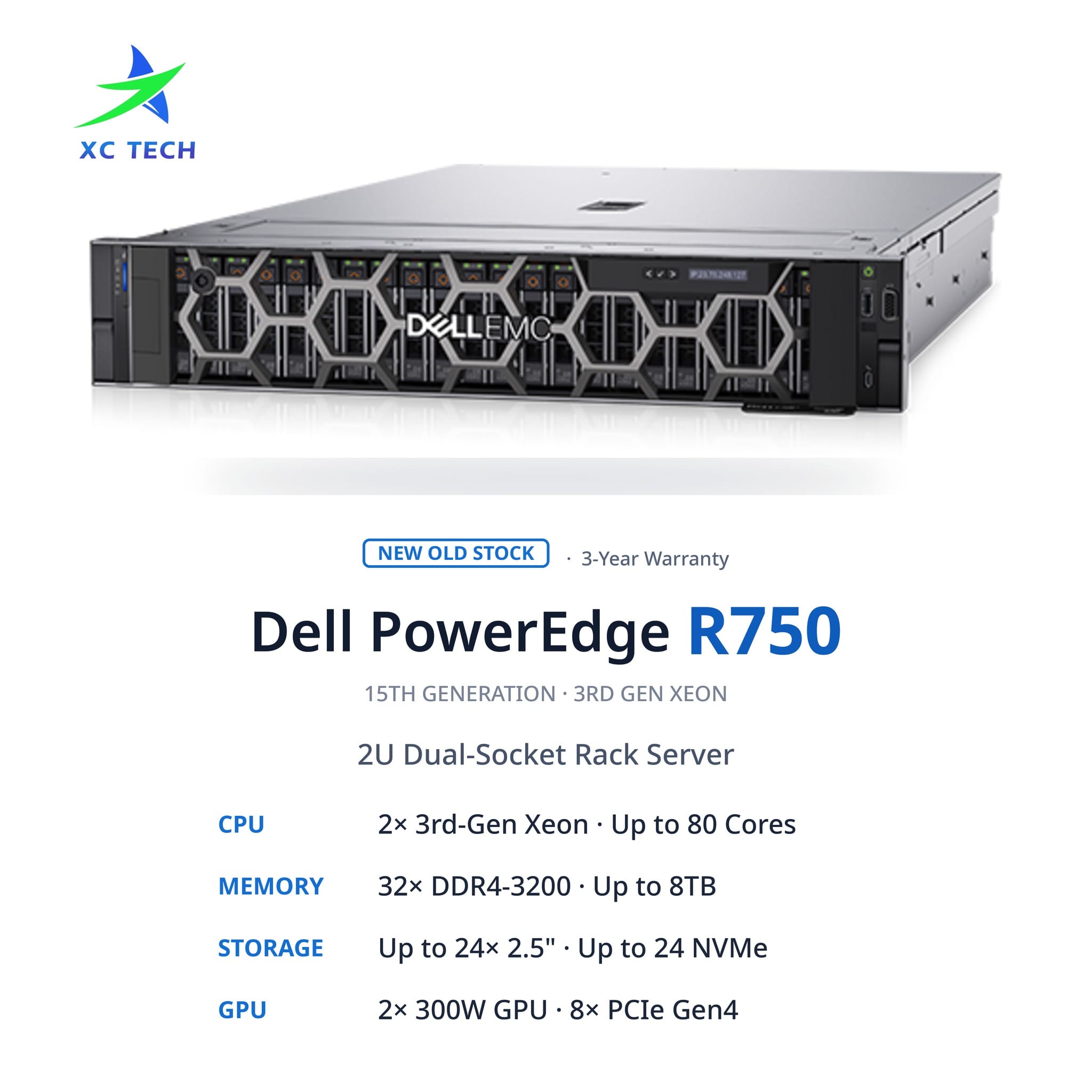
Both are 2U, dual-socket general-purpose rack servers for virtualization, databases, private cloud, HPC nodes and GPU-assisted workloads. They share the same chassis class, the same 24-drive front ceiling and iDRAC9 management. The difference is the generation:
- PowerEdge R750 — 15G. 3rd-Gen Intel Xeon Scalable (Ice Lake), from Silver 4300 to Platinum 8380, with DDR4-3200 and PCIe Gen4. Supply status: NEW OLD STOCK · FACTORY-SEALED. See the R750 product page.
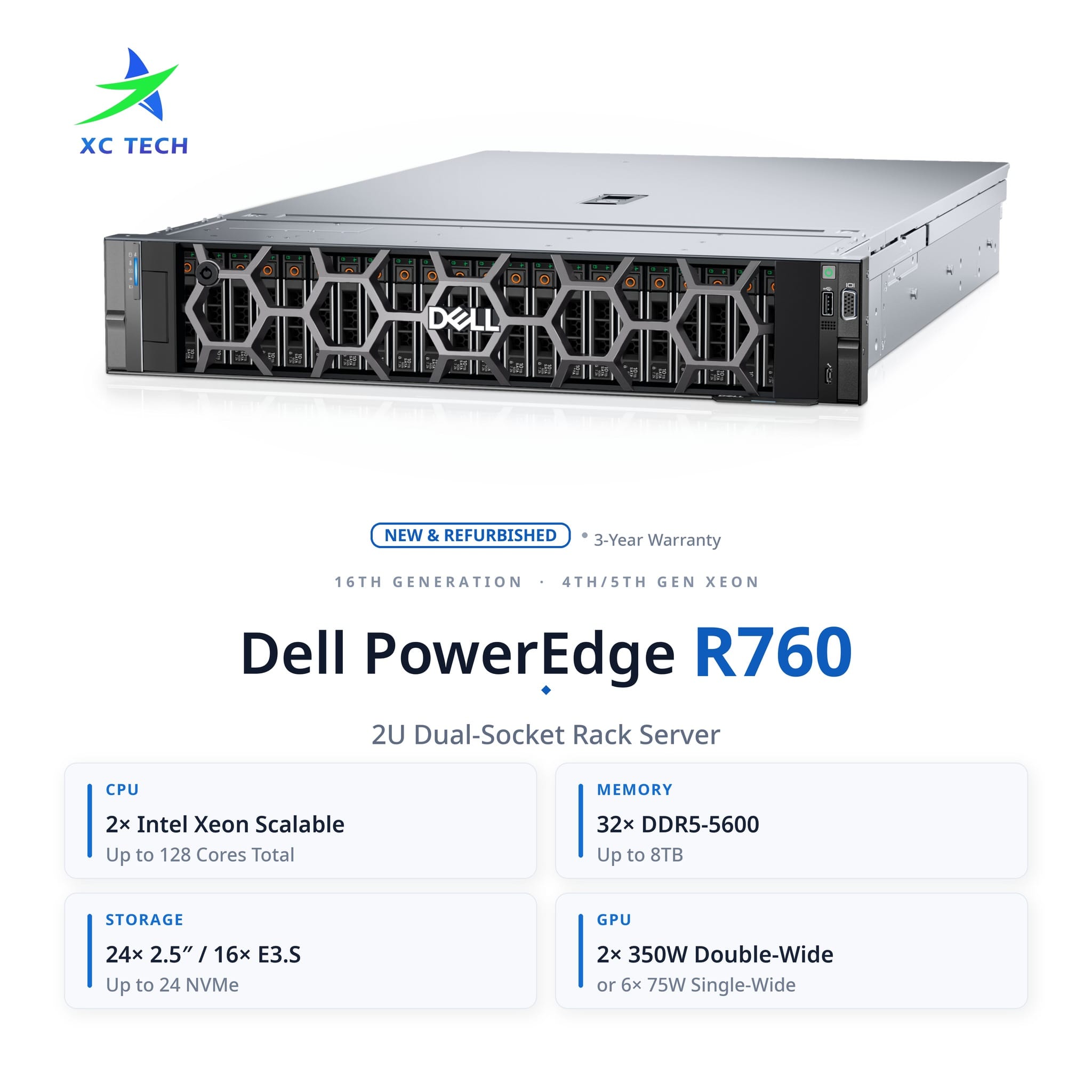
- PowerEdge R760 — 16G. 4th- and 5th-Gen Intel Xeon Scalable plus Xeon Max, with DDR5 and PCIe Gen5. Supply status: BRAND-NEW · FACTORY-SEALED, in current production. See the R760 product page.
See our PowerEdge generations overview and the Intel Xeon PowerEdge hub for the wider lineup.
Specs head to head
The table compares the published R750 and R760 specifications. NOS condition changes none of these numbers: they are the original factory specifications of a sealed-new 15G system.
| Specification | PowerEdge R750 (15G, NOS) | PowerEdge R760 (16G, new) |
|---|---|---|
| Generation | 15th generation (15G) | 16th generation (16G) |
| Processors | 3rd-Gen Intel Xeon Scalable (Ice Lake), Silver 4300 to Platinum 8380, dual socket | 4th & 5th-Gen Intel Xeon Scalable and Xeon Max, dual socket |
| Max cores | 40 cores / socket — 80 total | 64 cores / socket — 128 total |
| Max CPU TDP | 270 W | 350 W |
| Memory type & speed | DDR4-3200 RDIMM / LRDIMM | DDR5 RDIMM, 4800 MT/s (4th Gen) / 5600 MT/s (5th Gen) |
| DIMM slots | 32 | 32 |
| Max memory | 8 TB (LRDIMM) | 8 TB |
| CXL memory expansion | Not supported | CXL 1.1 |
| Front drive bays | 8 × 3.5", 12 × 3.5" or 24 × 2.5" | 8 × 3.5", 12 × 3.5" or 24 × 2.5" |
| Max front NVMe | Up to 24 | Up to 24 |
| PCIe slots | 8 × PCIe Gen4 | 8 × PCIe Gen5 |
| GPU support | Up to 2 double-width GPUs, 300 W max each | Up to 2 double-width GPUs, 350 W max each |
| RAID controllers | H345, H755 / H755N, HBA355i | H355, H755 / H755N, H965i, HBA465 |
| Power supplies | 800 / 1400 / 2400 / 2800 W | 800 / 1400 / 2400 / 2800 W |
| Management | iDRAC9 | iDRAC9 |
| Condition & warranty | NEW OLD STOCK · FACTORY-SEALED, never powered on, 3-year warranty | BRAND-NEW · FACTORY-SEALED current production, 3-year warranty |
Values from Dell’s published PowerEdge R750 and R760 specification sheets. Exact riser, backplane and RAID availability depends on the chassis configuration selected at order time.
1. CPU and cores: 80 versus 128 total
The R750 supports 3rd-Gen Xeon Scalable up to 40 cores per socket (80 in a dual-CPU build), with a 270 W maximum CPU TDP. The R760 supports 4th- and 5th-Gen Xeon Scalable and Xeon Max up to 64 cores per socket — 128 across two sockets — including 350 W high-power SKUs. For mainstream workloads under 80 cores the difference rarely shows. It matters for extreme VM consolidation, per-core-licensed software and builds expected to scale for four or five years.
2. Memory: DDR4-3200 versus DDR5-4800/5600
Both provide 32 DIMM slots and an 8 TB ceiling, so neither wins on capacity. The gap is bandwidth: the R750 runs DDR4-3200 RDIMMs or LRDIMMs, while the R760 runs DDR5 at 4800 MT/s with 4th-Gen and 5600 MT/s with 5th-Gen processors, plus CXL 1.1 memory expansion that no 15G platform offers. DDR5 bandwidth helps in-memory databases, large hypervisor hosts and analytics. If your estate already holds DDR4-3200 spares, the R750 keeps one memory standard; the R760 moves the pool to DDR5.
3. PCIe Gen5, NVMe and GPUs
Both offer eight PCIe slots and up to 24 front NVMe drives. On the R750 they run at Gen4; on the R760 at Gen5, doubling per-lane bandwidth for the fastest NVMe, next-generation NICs and accelerators. GPU support follows the same pattern — two double-width cards in either chassis, capped at 300 W each on the R750 versus 350 W on the R760. RAID steps forward from the R750’s H345 / H755 / H755N / HBA355i set to the R760’s H355 / H755 / H755N / H965i / HBA465 lineup. Gen5 matters only when Gen5 devices are on the bill of materials; Gen4 stays ample for mainstream all-flash storage and networking.
4. Same chassis, same storage ceiling
Do not mistake the older platform for a smaller one. The R750 and R760 share the same front-bay configurations — 8 × 3.5", 12 × 3.5" or 24 × 2.5" — the same 24-NVMe maximum, 8 TB memory ceiling and 800 / 1400 / 2400 / 2800 W PSU range, both on iDRAC9. A fully configured R750 NOS is a full-density 2U node. The gap sits in CPU, memory and PCIe technology, not drive count or chassis capacity.
The R750xs and R760xs value trims
If you do not need the full R750 ceiling, its same-generation value trim is the PowerEdge R750xs, also factory-sealed NOS with a 3-year warranty. Dell scales it back deliberately: 3rd-Gen Xeon Scalable from Silver 4300 to Gold 6338, up to 32 cores per socket (64 total) at a 205 W CPU TDP, 16 DDR4-3200 slots with a 1 TB maximum (not 32 slots, not 8 TB), five PCIe Gen4 slots instead of eight, PSUs up to 1400 W, and no double-width GPU support. Front-bay choices match the R750. Workloads inside those limits get an even friendlier acquisition cost.
The PowerEdge R760xs is the 16G equivalent: 16 DDR5 slots and up to 32 cores per socket for buyers who want the newer platform without the full R760 ceiling. For a 1U 15G footprint, the PowerEdge R650 is the same-generation alternative.
When to buy which
R750 NOS when…
- Mainstream virtualization, database or application workloads fit within 80 cores and DDR4.
- You hold DDR4-3200 spares and Gen4 adapters and want one memory and I/O standard.
- No Gen5 NVMe, CXL memory or 350 W GPU requirement is on the roadmap.
- Acquisition cost is a primary lever and you want a mature, immediately available sealed-new platform with a 3-year warranty.
Browse available builds on the R750 page.
New R760 when…
- The project has a long depreciation horizon and you want the longest remaining firmware and security runway.
- You need more than 80 cores, DDR5-4800/5600 bandwidth, PCIe Gen5 devices or CXL 1.1 expansion.
- You plan to deploy higher-power double-width GPUs (up to 350 W each) or next-generation NICs.
- You are standardizing the fleet on 4th/5th-Gen Xeon Scalable and DDR5 now.
Configure the current platform from the R760 page.
How we supply and support both
Beijing Xinchuan Technology Co., Ltd. ships both factory-sealed: the R750 as 15G new old stock, the R760 as brand-new current production. Each unit is configured to your bill of materials and tested before dispatch, both with a 3-year warranty. Because pricing depends on CPU, memory, drive, RAID and riser choices, we quote your exact configuration rather than a one-size price — send a target build through the quote form for a validated bill of materials.
Dell PowerEdge R760 16G brand-new, DDR5 and PCIe Gen5
Dell PowerEdge R750xs 15G value trim, also NOS sealed
Intel Xeon PowerEdge All Intel Xeon PowerEdge servers
Configure your R750 NOS or R760
Tell us your CPU count, RAM, drive layout and GPU needs. We will confirm which platform and chassis fit, then quote a factory-sealed unit with a 3-year warranty.
Frequently asked questions
What exactly is a factory-sealed R750 NOS?
It is new old stock: an original factory-sealed 15G server that has never been powered on or deployed. It is not a decommissioned, returned or remanufactured machine, and it ships with a 3-year warranty.
What is the real performance gap between the R750 NOS and the new R760?
The R750 reaches 40 cores per socket (80 total) on 3rd-Gen Xeon Scalable with DDR4-3200 and PCIe Gen4. The R760 reaches 64 cores per socket (128 total) on 4th and 5th-Gen Xeon Scalable with DDR5-4800/5600 and PCIe Gen5. Workloads under 80 cores rarely notice; dense consolidation and bandwidth-heavy jobs favor the R760.
Can the R750 be upgraded to DDR5 or 4th/5th-Gen Xeon later?
No. The 15G platform is fixed to 3rd-Gen Xeon Scalable, DDR4 DIMM slots and PCIe Gen4. DDR5 memory, 4th and 5th-Gen processors and PCIe Gen5 require the 16G R760.
How much memory and storage does each support?
Both the R750 and R760 have 32 DIMM slots, an 8 TB memory ceiling and support for up to 24 front NVMe drives. The difference is memory generation and speed: DDR4-3200 versus DDR5-4800/5600. The R750xs value trim is capped at 16 DIMM slots and 1 TB.
When does the R750xs make more sense than the full R750?
Choose the R750xs when you need no more than 32 cores per socket (64 total), no more than 1 TB of RAM across 16 slots, five PCIe Gen4 slots and no double-width GPUs, and a more favorable acquisition cost is a priority. It is the same 15G generation and is also factory-sealed NOS with a 3-year warranty.
Does the R750 NOS come with a warranty?
Yes. Every factory-sealed R750 NOS is a new, never-powered-on system and ships with a 3-year warranty, the same warranty term applied to current-production servers.
Which is more future-proof for a new 2026 deployment?
For the longest platform life, DDR5-4800/5600 memory, PCIe Gen5, CXL 1.1 expansion and up to 128 cores, choose the new R760. For mature mainstream workloads that fit within 80 cores on DDR4, the factory-sealed R750 NOS provides a sealed-new 2U platform at a friendlier acquisition cost.
Trademarks appear solely for product identification. Last reviewed 2026-09-19.

WeChat
Scan the QR Code with wechat