 serverbastion.com

AMD EPYC Dell PowerEdge Servers: The Complete Model List
Buying guide · Updated 2026-09-18 · 12 min read
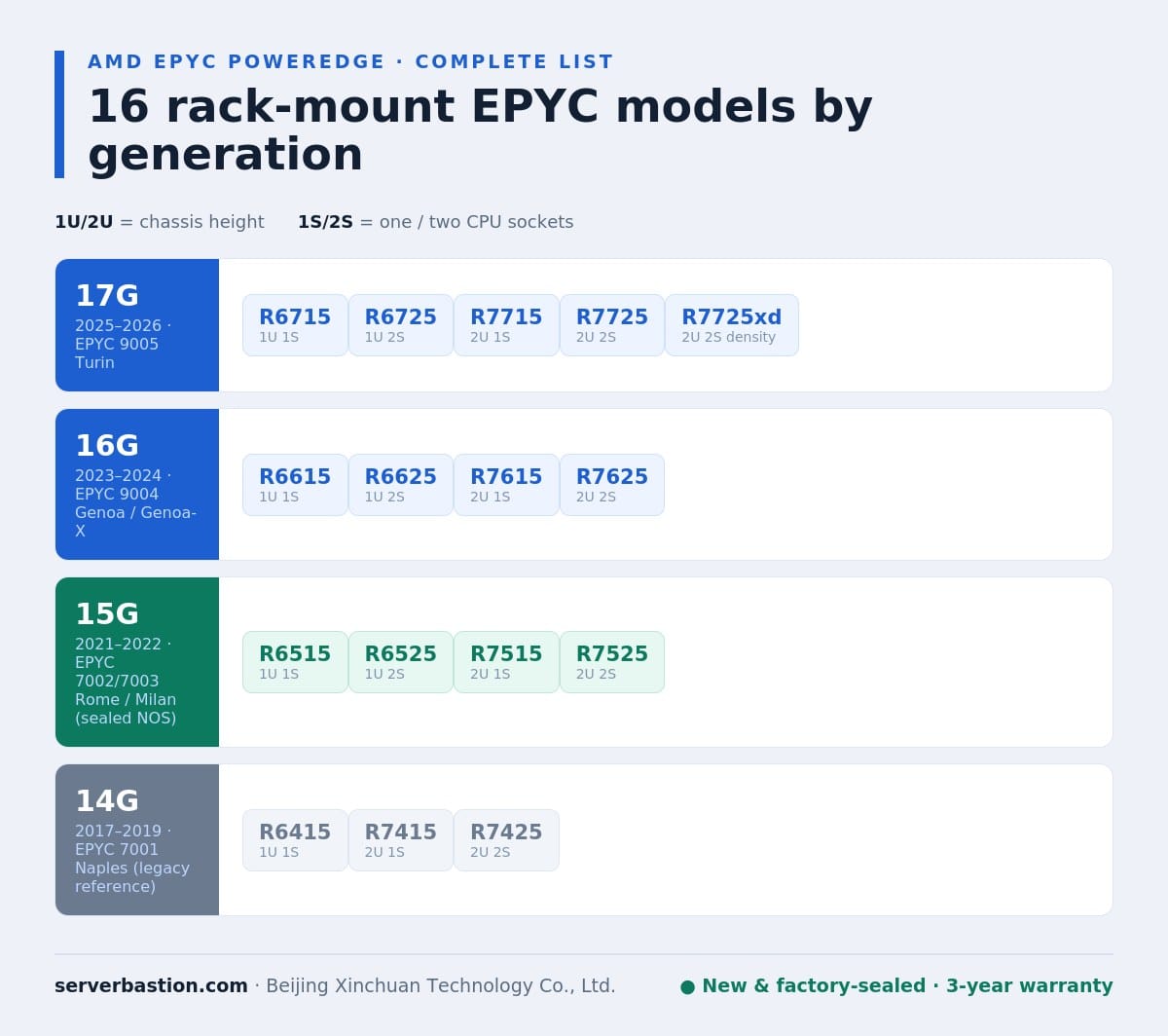
Dell uses a simple numbering rule for its PowerEdge rack line. Models ending in 0 (R770, R760, R750) are Intel; the same chassis with an AMD EPYC processor ends in 5 — the R7725 is the EPYC twin of the R770, the R7625 is the EPYC twin of the R760, and so on. The first digit marks the chassis (6 = 1U, 7 = 2U) and the middle digit marks the generation. If you are new to the generations themselves, our Dell PowerEdge generations guide explains 14G through 17G; here we focus on the AMD side of the family. You can also browse our full AMD EPYC server range.
EPYC generations at a glance
| Gen | Years | EPYC platform | Memory | PCIe |
|---|---|---|---|---|
| 17G | 2025-2026 | EPYC 9005 (Turin) | DDR5-5200/6400 | PCIe Gen5 |
| 16G | 2023-2024 | EPYC 9004 (Genoa/Genoa-X) | DDR5-4800 | PCIe Gen5 |
| 15G | 2021-2022 | EPYC 7002/7003 (Rome/Milan) | DDR4-3200 | PCIe Gen4 |
| 14G | 2017-2019 | EPYC 7001 (Naples) | DDR4-2666 | PCIe Gen3 |
Each step moved to a newer EPYC microarchitecture, faster memory and a new PCIe generation. The 14G Naples line used DDR4-2666 and PCIe Gen3; 15G Rome/Milan moved to DDR4-3200 and PCIe Gen4; 16G Genoa introduced DDR5 and PCIe Gen5 with E3.S drives; and the newest 17G Turin line raises the memory speed to DDR5-6400 and the single-socket core ceiling to 160.
The complete table: all 16 rack-mount EPYC PowerEdge servers
| Model | Gen | Socket | CPU platform | Max cores | Memory | Max NVMe / E3.S | PCIe |
|---|---|---|---|---|---|---|---|
| R6415 | 14G | 1× | EPYC 7001 (Naples) | 32C | 16× DIMMs, 512GB RDIMM, 2666 MT/s | 10× NVMe | PCIe Gen3 |
| R7415 | 14G | 1× | EPYC 7001 (Naples) | 32C | 16× DIMMs, 1TB LRDIMM, 2666 MT/s | 24× NVMe | PCIe Gen3 |
| R7425 | 14G | 2× | EPYC 7001 (Naples) | 32C×2 (64 cores total) | 32× DIMMs, 2TB LRDIMM, 2666 MT/s | 24× NVMe | PCIe Gen3 |
| R6515 | 15G | 1× | EPYC 7002/7003 (Rome/Milan) | up to 64 cores | 16× DIMMs, RDIMM, 3200 MT/s | up to 10× NVMe (front) | PCIe Gen4 |
| R6525 | 15G | 2× | EPYC 7002/7003 (Rome/Milan) | up to 64 cores per socket | 32× DIMMs, RDIMM 2TB, 3200 MT/s | up to 10 front + 2 rear NVMe (12 total) | PCIe Gen4 |
| R7515 | 15G | 1× | EPYC 7002/7003 (Rome/Milan) | up to 64 cores | 16× DIMMs, RDIMM, 3200 MT/s | up to 24× NVMe (front) | PCIe Gen4 |
| R7525 | 15G | 2× | EPYC 7002/7003 (Rome/Milan) | up to 64 cores per socket | 32× DIMMs, RDIMM 2TB, 3200 MT/s | up to 24× NVMe (front) | PCIe Gen4 |
| R6615 | 16G | 1× | EPYC 9004 (Genoa/Genoa-X) | 128(9754) | 12 RDIMM DIMMs, 3TB, 4800 MT/s | 16 (16×E3.S) or 8/10×2.5 + 2 rear E3.S | PCIe Gen5 |
| R6625 | 16G | 2× | EPYC 9004 (Genoa/Genoa-X) | 128(9754) | 24 RDIMM DIMMs, 6TB, 4800 MT/s | 16 (16×E3.S) or front 2.5 + rear E3.S | PCIe Gen5 |
| R7615 | 16G | 1× | EPYC 9004 (Genoa/Genoa-X) | 128(9754) | 12 RDIMM DIMMs, 3TB, 4800 MT/s | 32 (32×E3.S Gen5) or 24×2.5 | PCIe Gen5 |
| R7625 | 16G | 2× | EPYC 9004 (Genoa/Genoa-X) | 128(9754) | 24 RDIMM DIMMs, 6TB, 4800 MT/s | 32 (32×E3.S) or 24×2.5 | PCIe Gen5 |
| R6715 | 17G | 1× | EPYC 9005 (Turin) | 160C | 24 DIMMs, 3TB RDIMM, 5200 MT/s | up to 22 (20 front E3.S + 2 rear E3.S) | PCIe Gen5 |
| R6725 | 17G | 2× | EPYC 9005 (Turin) | 192C×2 | 24 DIMMs, 6TB RDIMM (3TB at launch*), 6400 MT/s | up to 22 (20 front + 2 rear E3.S) | PCIe Gen5 |
| R7715 | 17G | 1× | EPYC 9005 (Turin) | 160C | 24 DIMMs, 6TB RDIMM, 5200 MT/s | up to 40 (40×E3.S) | PCIe Gen5 |
| R7725 | 17G | 2× | EPYC 9005 (Turin) | 192C×2 | 24 DIMMs, 6TB RDIMM, 6400 MT/s | up to 40 (40×E3.S) | PCIe Gen5 |
| R7725xd | 17G | 2× | EPYC 9005 (Turin) | 192C×2* | 24 DIMMs, 3TB RDIMM*, 6400 MT/s | 24 | PCIe Gen5 |
Specifications are maximums from Dell official technical documentation for each model. DIMM counts, memory capacity and NVMe/E3.S limits vary by chassis configuration; exact build is confirmed at quotation.
17G EPYC (2025-2026): R6715, R6725, R7715, R7725 and R7725xd
Turin — EPYC 9005, DDR5-6400, PCIe Gen5
The newest generation is built on AMD EPYC 9005 “Turin”. It pushes the dual-socket 2U R6725/R7725 to up to 192 cores per socket, adds DDR5 at up to 6400 MT/s, up to 40 E3.S Gen5 NVMe drives in the 2U chassis and up to three 450W double-width GPUs in the single-socket R7715. The R7725xd is a storage-specialist dual-socket node with 24 U.2 Gen5 NVMe bays and no internal RAID controller (BOSS-N1 boot only). These are brand-new, current-production platforms with a 3-year manufacturer warranty.
| Model | Socket | Max cores | Memory | Front bays | GPU |
|---|---|---|---|---|---|
| PowerEdge R6715 | single-socket | 160C | 24, 3TB RDIMM, 5200 MT/s | 4×3.5″ / 8×2.5 Universal or U.2 / 10×2.5 / 16×E3.S / 20×E3.S / 2×U.2 | up to 3×75W single-width (SW) |
| PowerEdge R6725 | dual-socket | 192C×2 | 24, 6TB RDIMM (3TB at launch*), 6400 MT/s | 4×3.5″ / 8×2.5 Universal or U.2 / 10×2.5 / 8/16/20×E3.S / 2×U.2 | up to 3×75W single-width (SW) |
| PowerEdge R7715 | single-socket | 160C | 24, 6TB RDIMM, 5200 MT/s | 12×3.5″ / 8×2.5 Universal, 16 or 24×2.5″ / 16×2.5 SSD+8×U.2 / 8/16/32/40×E3.S / 2×U.2 | up to 3×450W double-width (DW) + up to 6×75W single-width (SW) |
| PowerEdge R7725 | dual-socket | 192C×2 | 24, 6TB RDIMM, 6400 MT/s | 12×3.5″ / 8×2.5 Universal, 16 or 24×2.5″ / 16×2.5+8×U.2 / 8/16/32/40×E3.S | up to 2×450W double-width (DW) or up to 6×75W single-width (SW) |
| PowerEdge R7725xd | dual-socket | 192C×2* | 24, 3TB RDIMM*, 6400 MT/s | 24×2.5″ U.2 Gen5 NVMe (max 2928TB*) | Not supported (N/A) |
- R7715 — the flagship single-socket 2U: up to 160 cores on one EPYC 9005 CPU, 6 TB of DDR5, 40 E3.S drives, up to 8 PCIe Gen5 slots and up to three double-width GPUs.
- R7725 — the dual-socket 2U flagship: up to 192 cores per socket, 6 TB DDR5-6400, 40 E3.S drives, the choice for the largest database and virtualization estates.
- R6715 / R6725 — the 1U versions (single- and dual-socket), up to 22 E3.S drives and three single-width GPUs for dense hosting.
- R7725xd — ultra-dense all-flash 2U storage node, 24 U.2 Gen5 NVMe bays (up to roughly 2.9 PB), GPUs not supported.
16G EPYC (2023-2024): R6615, R6625, R7615 and R7625
Genoa / Genoa-X — EPYC 9004, DDR5-4800, PCIe Gen5
The 16G generation brought AMD onto DDR5 and PCIe Gen5 with E3.S storage. Every model supports up to 128 cores per socket (EPYC 9754-class). The single-socket R6615 and R7615 use 12 DIMMs and cap at 3 TB, while the dual-socket R6625 and the in-stock PowerEdge R7625 use 24 DIMMs and reach 6 TB. These remain brand-new, factory-sealed servers with a 3-year manufacturer warranty and are the price-performance sweet spot for new EPYC builds.
| Model | Socket | Max cores | Memory | Front bays | GPU |
|---|---|---|---|---|---|
| PowerEdge R6615 | single-socket | 128(9754) | 12 DDR5 RDIMM, 3TB, 4800 MT/s | 4×3.5 / 8×2.5 NVMe / 10×2.5 / 14×E3.S / 16×E3.S | 2×75W single-width |
| PowerEdge R6625 | dual-socket | 128(9754) | 24 DDR5 RDIMM, 6TB, 4800 MT/s | 4×3.5/8×2.5 NVMe/10×2.5/14×E3.S/16×E3.S | 3×75W single-width |
| PowerEdge R7615 | single-socket | 128(9754) | 12 DDR5 RDIMM, 3TB, 4800 MT/s | 8×3.5/12×3.5/8×2.5/16×2.5/24×2.5/8/16/32×E3.S | 3× DW full-height full-length (300W class) or 6×75W SW |
| PowerEdge R7625 | dual-socket | 128(9754) | 24 DDR5 RDIMM, 6TB, 4800 MT/s | 8×3.5/12×3.5/8×2.5/16×2.5/24×2.5/8/16/32×E3.S | 2×300W DW or 6×75W SW |
15G EPYC (2021-2022): R6515, R6525, R7515 and R7525 — sealed NOS
Rome / Milan — EPYC 7002/7003, DDR4-3200, PCIe Gen4
The 15G Rome/Milan line is available from us as brand-new, factory-sealed New Old Stock rather than as used hardware. The dual-socket 2U PowerEdge R7525 and 1U PowerEdge R6525 support up to 64 cores per socket and 4 TB with LRDIMMs; the single-socket PowerEdge R7515 leads with up to 24 front NVMe bays. PCIe Gen4 and DDR4-3200 still cover the majority of virtualization, database and general workloads. Every sealed NOS unit carries a full 3-year warranty backed directly by Beijing Xinchuan Technology Co., Ltd.. Read more about what New Old Stock means.
| Model | Socket | Max cores | Memory | Front bays | GPU |
|---|---|---|---|---|---|
| PowerEdge R6515 | single-socket | up to 64 cores | 16× DDR4, RDIMM/LRDIMM up to 2TB, 3200 MT/s | front 4×3.5″ or 10×2.5″ | up to 2× 75W single-width GPUs (e.g. T4) |
| PowerEdge R6525 | dual-socket | up to 64 cores per socket | 32× DDR4, RDIMM 2TB / LRDIMM 4TB, 3200 MT/s | front 4×3.5″ or 10×2.5″ (8×2.5 NVMe optional) | up to 2× 75W single-width GPUs (e.g. T4) |
| PowerEdge R7515 | single-socket | up to 64 cores | 16× DDR4, RDIMM/LRDIMM up to 2TB, 3200 MT/s | front 8×3.5″/16×2.5″/24×2.5″ | up to 4× 75W single-width GPUs (e.g. T4) |
| PowerEdge R7525 | dual-socket | up to 64 cores per socket | 32× DDR4, RDIMM 2TB / LRDIMM 4TB, 3200 MT/s | front 8/12×3.5″ or 16/24×2.5″ | 3×300W double-width or 6×75W single-width |
14G EPYC (2017-2019): R6415, R7415 and R7425 — legacy reference
Naples — EPYC 7001, DDR4-2666, PCIe Gen3
The first EPYC PowerEdge models used the original EPYC 7001 “Naples” processors at up to 32 cores per socket, DDR4-2666 and PCIe Gen3. We list them for completeness and to help you identify older equipment, but we do not carry 14G as a new line. If you are evaluating a Naples-class build, a sealed 15G R6525/R7515/R7525 (Rome/Milan) or a new 16G/17G platform gives you a supported, warranted and far faster starting point.
| Model | Socket | Max cores | Memory | Front bays | GPU |
|---|---|---|---|---|---|
| PowerEdge R6415 | single-socket | 32C | 16× DDR4, 512GB RDIMM / 1TB LRDIMM, 2666 MT/s | 4×3.5″ or 8×2.5″ or 10×2.5″ (NVMe included) | none |
| PowerEdge R7415 | single-socket | 32C | 16× DDR4, 1TB LRDIMM, 2666 MT/s | 12×3.5″ or 24×2.5″ | none |
| PowerEdge R7425 | dual-socket | 32C×2 (64 cores total) | 32× DDR4, 2TB LRDIMM, 2666 MT/s | 12×3.5″ or 24×2.5″ | 3×300W DW or 6×150W SW |
Single-socket vs dual-socket, and 1U vs 2U
AMD's high per-socket core counts make single-socket EPYC servers unusually capable. A single-socket R7715 already provides up to 160 cores, which removes the second CPU — and its licensing and memory cost — for many workloads. Choose a dual-socket model when you need the extra memory channels, DIMM slots and PCIe lanes of a second socket. The 1U R6x15/R6x25 models maximise density in the rack; the 2U R7x15/R7x25 models add drive bays, GPU room and expansion slots. For a step-by-step method to size CPU, memory, storage and PSU, see our R760/R770 configuration guide — the same rules apply to the EPYC chassis.
How we sell and warrant AMD EPYC PowerEdge servers
- Brand-new current production — the 17G and 16G models ship factory-sealed with a 3-year manufacturer warranty.
- Sealed New Old Stock — the 15G R6525, R7515 and R7525 are new, unopened units clearly identified as NOS, with a full 3-year warranty directly backed by Beijing Xinchuan Technology Co., Ltd..
- Configuration to order — CPU SKU, DIMMs, NVMe/HDD, RAID and NICs are built and tested to your specification; we quote within one business day.
- Independent multi-brand supply — we are an independent B2B supplier and exporter of Dell, Lenovo, xFusion, Inspur and Huawei systems; trademarks are used for identification only. More in why buyers order from us and the full warranty terms.
Get a quote on new PowerEdge servers
Tell us the EPYC model (for example R7625 or R7725), CPU, memory, drives and quantity. We will reply within one business day with a firm channel price, lead time and warranty confirmation.
Or email info@sell-server.com. New units ship factory-sealed with a 3-year manufacturer warranty; sealed previous-generation stock is clearly identified as New Old Stock.
Frequently asked questions
Which Dell PowerEdge servers use AMD EPYC processors?
Dell ships AMD EPYC in its 15-suffix rack range (the Intel equivalents end in 0). Across the four current generations these are the R6415, R7415 and R7425 (14G, EPYC 7001 Naples); the R6515, R6525, R7515 and R7525 (15G, EPYC 7002 Rome / 7003 Milan); the R6615, R6625, R7615 and R7625 (16G, EPYC 9004 Genoa); and the R6715, R6725, R7715, R7725 and R7725xd (17G, EPYC 9005 Turin).
What is the difference between the R7525 and the R7725?
The R7525 is the 15th-generation dual-socket 2U built on EPYC 7002/7003 (Rome/Milan) with 32 DDR4-3200 DIMMs, up to 4 TB with LRDIMMs, PCIe Gen4 and 24 front NVMe drives. The R7725 is the newest 17th-generation dual-socket 2U on EPYC 9005 (Turin), with up to 192 cores per socket, 24 DDR5 DIMMs at up to 6400 MT/s, 6 TB of RDIMM, up to 40 E3.S Gen5 NVMe drives and PCIe Gen5. The R7725 is the higher-core-count, higher-bandwidth, longer-lifecycle platform; the sealed R7525 is the value option.
What is the most powerful single-socket AMD PowerEdge?
The 17th-generation PowerEdge R7715, a 2U single-socket server built on EPYC 9005 (Turin) with an official ceiling of 160 cores, 24 DDR5 DIMMs at 5200 MT/s, up to 6 TB of RDIMM, as many as 40 E3.S Gen5 NVMe drives, up to 8 PCIe Gen5 slots and up to three double-width GPUs. The 1U single-socket counterpart is the R6715 (up to 160 cores, 3 TB, 22 E3.S drives).
Is the PowerEdge R7625 a good server in 2026?
Yes. The R7625 is the 16th-generation dual-socket 2U on EPYC 9004 (Genoa/Genoa-X), with up to 128 cores per socket, 24 DDR5-4800 DIMMs, up to 6 TB of memory, 32 E3.S drives and PCIe Gen5. It is a brand-new, factory-sealed platform that covers dense virtualization, database and HPC workloads at a sharper price than the newest 17G R7725, and ships with a 3-year manufacturer warranty.
Should I buy a single-socket or dual-socket EPYC PowerEdge?
Single-socket models (R6515, R7515, R6615, R7615, R6715, R7715) give you the high core count of one EPYC CPU with half the licensing and memory cost and are ideal for single-license virtualization, storage and edge. Dual-socket models (R6525, R7525, R6625, R7625, R6725, R7725) double the memory channels, DIMMs and PCIe lanes for the largest databases, dense VDI and HPC. If one socket meets your core target, it is usually the better-value build.
Are 15G EPYC servers still available new?
The 15G R6525, R7515 and R7525 are available as brand-new, factory-sealed New Old Stock rather than used machines. They run EPYC 7002/7003 with DDR4-3200 and PCIe Gen4, which still covers most mainstream workloads, and every sealed NOS unit we supply carries a full 3-year warranty directly backed by Beijing Xinchuan Technology Co., Ltd. Brand-new 17G/16G servers carry the standard 3-year manufacturer warranty; 14G (Naples) is a legacy platform we no longer carry new.
How many cores can an AMD EPYC PowerEdge hold?
It depends on the generation and chassis. The newest 17G dual-socket R6725 and R7725 support EPYC 9005 processors with up to 192 cores per socket, while the single-socket R6715 and R7715 top out at 160 cores on one CPU. The 16G Genoa line reaches 128 cores per socket, 15G Rome/Milan reaches 64 cores per socket, and the original 14G Naples line reached 32 cores per socket.
PowerEdge R762516G dual-socket 2U, EPYC 9004, up to 128 cores/socket
R7725 vs R7625 compared17G Turin vs 16G Genoa: up to 384 cores, DDR5-6400, 40 E3.S and 450 W GPUs
PowerEdge R7525Sealed 15G dual-socket 2U, Rome/Milan, up to 4 TB
PowerEdge generations 14G-17GHow the Intel and AMD generations line up
Specifications reflect official Dell PowerEdge technical documentation for the 17th-, 16th- and 15th-generation rack servers and our internal configuration database. Dell, PowerEdge and Xeon are trademarks of their respective owners and are used for identification only. Servers are sold and warranted by Beijing Xinchuan Technology Co., Ltd.. This article was last reviewed on 2026-09-17.

WeChat
Scan the QR Code with wechat