 serverbastion.com

What Is a “New Old Stock” Server? New vs NOS Explained
Buying guide · Updated 2026-09-17 · 7 min read
The terminology around new servers is deliberately confusing: “new,” “new old stock,” “open-box,” “previously deployed” and “grade A” all mean different things, and some sellers blur them on purpose. Here is exactly what NOS means and how to buy it without getting someone else's retired hardware.
The one-sentence definition
A New Old Stock server is a server that was manufactured as new, never sold into production or powered on as a working system, and remains in its original, unopened factory packaging, but is from a previous product generation or an older production lot.
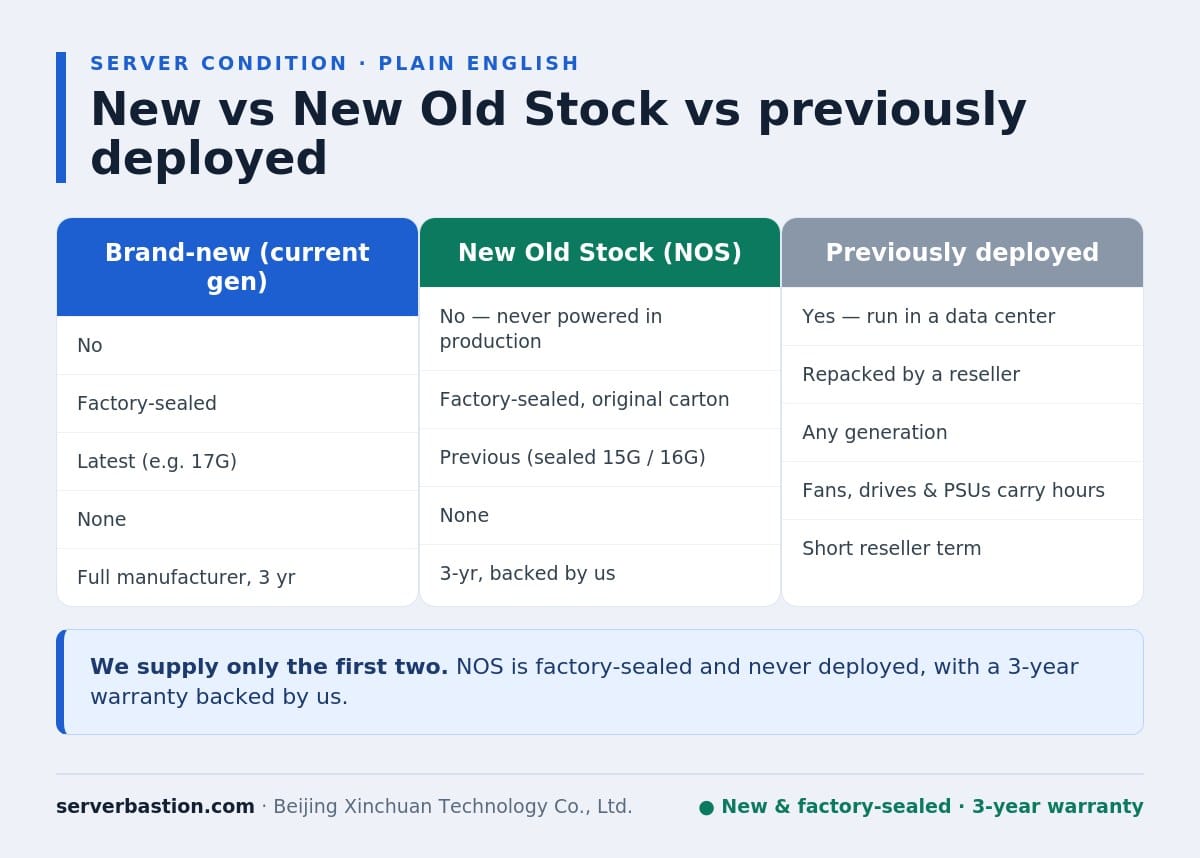
New vs New Old Stock vs previously deployed
| Brand-new (current gen) | New Old Stock (NOS) | Previously deployed (not in our range) | |
|---|---|---|---|
| Ever deployed/run? | No | No — never powered in production | Yes — previously run in a data center |
| Packaging | Factory-sealed | Factory-sealed, original carton | Repacked by a reseller |
| Generation | Latest (e.g. 17G) | Previous (e.g. sealed 15G/16G) | Any generation |
| Wear / component life used | None | None | Yes — fans, drives and PSUs carry run hours |
| Warranty | Full manufacturer (3 yr) | 3-year warranty backed by us (does not depend on build date) | Short reseller term (we do not supply these) |
| Price | Highest | Lower — the value sweet spot | Lowest entry price |
Where New Old Stock servers come from
- Over-ordered projects. A large deployment buys spare units that are never installed.
- Distribution end-of-life clearance. When a new generation launches, distributors clear sealed older inventory to free space.
- Cancelled or refused orders. Sealed stock returned to the channel without ever being opened.
Because the box was never opened, the components inside have zero runtime: no fan hours, no SSD writes, no thermal cycling. That is the crucial distinction from previously deployed, secondary-market equipment, regardless of how clean a retired chassis looks.
Why NOS is frequently the smartest buy
Most production workloads — virtualization, file and application serving, domain/AD, smaller databases, backup targets, edge and branch servers — do not need the newest silicon. A sealed previous-generation server gives you new-hardware reliability at a discount, and often frees budget to add more RAM or NVMe. For example, a factory-sealed 15th-generation PowerEdge R750 (2U) or R650 (1U) still provides up to 80 cores across two Xeon Scalable CPUs, 32 DIMM slots and up to 8 TB of memory — capability that over-serves many environments. The cost-optimized 15G siblings, the R750xs, target buyers who want a sealed new 2U at the lowest entry price and do not need maximum expansion. Because remaining manufacturer coverage on older sealed stock can vary, we back every such NOS unit with our own full 3-year warranty rather than relying on any manufacturer term.
The risks — and how to remove them
- “NOS” used as a euphemism for previously deployed hardware. Fix: require a written “factory-sealed, never deployed” commitment and intact Dell security seals.
- Warranty start date or region. The manufacturer warranty on older sealed stock may be tied to the original sale date or region, so a unit's remaining manufacturer cover can be uncertain. Fix: buy from a supplier who takes on a defined warranty themselves — we provide a full 3-year warranty on every NOS unit we sell, independent of the build date — and still verify the service tag for model and configuration.
- Shelf-life of consumables. A sealed server can sit for years; CMOS batteries can drain and, rarely, capacitors or HDDs (if included) can be affected by long storage. Fix: buy from a supplier who power-tests sealed NOS or accepts an immediate burn-in window, and prefer factory-integrated SSDs/NVMe over old spinning stock.
- Older BIOS/firmware. Expected and harmless. Fix: update BIOS, iDRAC and drive firmware from Dell on deployment.
Questions to ask any NOS seller
- Can you confirm in writing it is factory-sealed and has zero runtime?
- What is the service tag, and what does Dell show for ship date and warranty?
- What exact warranty term applies in my country, and how is an RMA handled?
- When was the unit manufactured, and how has it been stored?
- What is your DOA policy if it fails first boot or burn-in?
Our NOS offering
We keep sealed 15th-generation PowerEdge stock — including the R750, R650 and R750xs — clearly labeled New Old Stock, never mixed with previously deployed or secondary-market units. They ship sealed and are verified by service tag. Crucially, because remaining manufacturer coverage on older sealed stock can vary, every NOS unit we sell carries a full 3-year warranty backed directly by us (Beijing Xinchuan Technology Co., Ltd.) — your cover does not depend on the build date or any manufacturer warranty clock. If you would rather have the very latest platform, the 17G R770 and R670 are current-generation new; the 16G R760/R660 sit in between. Compare all of them in the Intel Xeon server range or read the full warranty terms.
Get a quote on new PowerEdge servers
Tell us the workload and your budget ceiling. We will quote the right tier honestly — current-generation brand-new or factory-sealed New Old Stock — with service tag and warranty details.
Or email info@sell-server.com. New units ship factory-sealed with a 3-year manufacturer warranty; sealed previous-generation stock is clearly identified as New Old Stock.
Frequently asked questions
Does New Old Stock mean the server is used?
No. NOS hardware is new and unused, with zero production runtime, still in its factory-sealed packaging. “Old” refers only to the generation or production date, not to wear. A previously deployed or secondary-market server, by contrast, has actually run in a data center.
Does an NOS server have a warranty?
Yes — when you buy NOS from us. Because the manufacturer warranty on older sealed stock can be tied to the original sale date or region and may be partly expired, we do not rely on it: every New Old Stock PowerEdge we sell carries a full 3-year warranty directly backed by Beijing Xinchuan Technology Co., Ltd., so your cover is fixed at 3 years regardless of the build date. We also share the service tag so you can verify model and configuration.
How does NOS differ from a previously deployed server?
NOS has zero component runtime and intact factory seals, whereas a previously deployed server has real run hours on the fans, drives and PSUs and is typically repacked by a reseller. We supply only brand-new and factory-sealed NOS PowerEdge servers, not previously deployed units. NOS costs less than current-generation new, placing it in the value sweet spot.
Which PowerEdge generations do you sell as NOS?
We supply sealed 15th-generation PowerEdge servers — the R750, R650 and R750xs — explicitly labeled New Old Stock, alongside brand-new 17th-generation (R770/R670) and 16th-generation (R760/R660) units.
Related servers
Specifications reflect official Dell PowerEdge technical documentation for the 17th-, 16th- and 15th-generation rack servers and our internal configuration database. Dell, PowerEdge and Xeon are trademarks of their respective owners and are used for identification only. Servers are sold and warranted by Beijing Xinchuan Technology Co., Ltd.. This article was last reviewed on 2026-09-17.

WeChat
Scan the QR Code with wechat