 serverbastion.com

Dell PowerEdge R770 vs R760: Which New 2U Server Should You Buy?
Buying guide · Updated 2026-09-17 · 8 min read
Both the PowerEdge R770 and the PowerEdge R760 are dual-socket 2U rack servers, both are available from us brand-new and factory-sealed, and both carry a 3-year manufacturer warranty. The difference is the generation: the R770 is Dell's 17th-generation rack server built on the latest Intel Xeon 6 platform, while the R760 is the 16th-generation design that shipped in volume and remains a safe, well-understood workhorse.
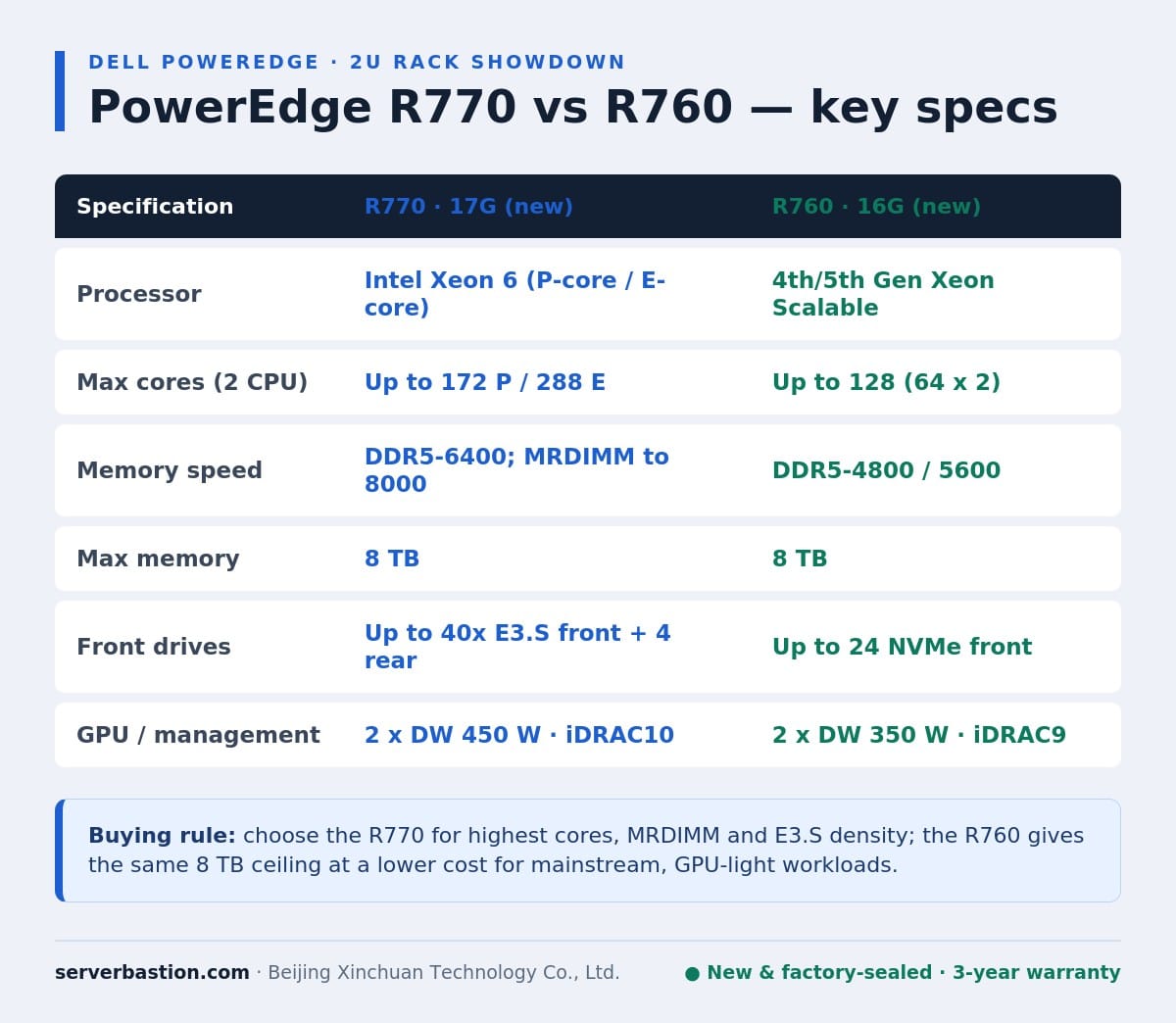
R770 vs R760 specification comparison
| Specification | PowerEdge R770 (17G, new) | PowerEdge R760 (16G, new) |
|---|---|---|
| Form factor | 2U dual-socket rack | 2U dual-socket rack |
| Processor family | Intel Xeon 6 (P-core / E-core scalable) | 4th/5th Gen Intel Xeon Scalable |
| Max cores (2 CPUs) | Up to 172 P-cores; up to 288 with E-core SKUs | Up to 128 cores (64 × 2) |
| Memory slots | 32 DIMM slots | 32 DIMM slots |
| Memory type / speed | DDR5-6400; MRDIMM up to 8000 MT/s | DDR5-4800 / 5600 MT/s |
| Max memory | 8 TB | 8 TB |
| Max front drives | Up to 44 NVMe/E3.S + 4 rear | Up to 24 NVMe front bays |
| PCIe expansion | 8 × PCIe Gen5 slots | 8 × PCIe Gen5 slots |
| GPUs | Up to 2 double-wide / 450 W-class accelerators | Up to 2 double-wide / 350 W-class GPUs |
| Redundant PSU | Yes (up to 2 high-wattage units) | Yes (up to 2 × 350 W-class) |
| Management | iDRAC10 | iDRAC9 |
| Condition we supply | Brand-new, factory-sealed | Brand-new, factory-sealed |
| Warranty | 3-year manufacturer warranty | 3-year on new units |
Configurations vary by region and by Dell's current option matrix; the values above are the published maximums. We confirm the exact buildable SKU and price on every quote.
When the R770 is the better buy
- You need the highest core count per rack unit. Dense virtualization hosts, large VDI farms and CPU-licensed per-socket workloads benefit most from 172 P-cores (or the high-throughput E-core options).
- Memory bandwidth matters. MRDIMM at up to 8000 MT/s meaningfully lifts in-memory databases, analytics and data-engineering pipelines versus 5600 MT/s DDR5.
- You want the longest support runway. A 17th-generation platform gives you the newest iDRAC10 management and the longest remaining software/firmware lifecycle.
- Maximum local NVMe. The R770's up-to-44 NVMe/E3.S front-loading design suits all-flash hyper-converged and storage-dense nodes.
When the R760 is the smarter choice
- The workload does not need 172 cores. Most general virtualization, web/application, ERP and small-to-mid database clusters sit comfortably inside 128 cores and 8 TB of DDR5.
- You want PCIe Gen5 without paying the newest-generation premium. The R760 already offers 8 Gen5 slots and up to 24 NVMe drives — the same I/O generation as the R770.
- Budget discipline. A factory-sealed R760 from channel stock often delivers nearly identical real-world performance at a lower acquisition cost, which shortens payback on larger fleets.
- Fleet standardization. If you already run 16th-generation hosts, adding more R760s keeps spares, BIOS baselines and iDRAC9 procedures identical.
Can you mix R770 and R760 in the same cluster?
Yes. Because both are x86 dual-socket servers with PCIe Gen5 and standard DDR5 ECC memory, they coexist cleanly in VMware, Hyper-V, Proxmox, OpenStack/KVM and container platforms. A common pattern is to place the highest-core R770s as compute/head nodes and use value-priced R760s for the bulk of the cluster. Keep a consistent hypervisor version and account for the different core counts in your licensing and NUMA planning.
Price and availability: the honest part
We do not publish fixed list prices because server cost moves with CPU SKU, memory, drives, quantity and freight, and Dell's own direct configurator frequently shows popular builds as temporarily unavailable. As a channel supplier we hold both new current-generation (R770/R670) and new previous-generation (R760/R660) stock, so you can compare real, firm prices for both generations in one quote instead of guessing from list price. Send your BOM — we come back with the exact configuration, condition, warranty and lead time.
Final recommendation
Choose the R770 when core density, MRDIMM bandwidth, the biggest NVMe footprint and the longest lifecycle justify the flagship price — especially for new three-to-five-year platforms. Choose the R760 when a factory-sealed, PCIe Gen5, 8 TB-memory 2U server at a better channel price is the financially rational answer — which, for a great many production workloads, it is. If you are also considering 1U, read the R670 and R660 1U pair, or start from the full Intel Xeon server range.
Get a quote on new PowerEdge servers
Tell us the CPU, memory, drive and quantity you need and we will come back with a firm channel price and lead time.
Or email info@sell-server.com. New units ship factory-sealed with a 3-year manufacturer warranty; sealed previous-generation stock is clearly identified as New Old Stock.
Frequently asked questions
Is the R760 still worth buying new after the R770 launched?
Yes for most workloads. The R760 still offers up to 128 cores, 8 TB of DDR5, 24 NVMe drives and 8 PCIe Gen5 slots, all brand-new with a 3-year warranty. Unless you specifically need MRDIMM bandwidth or 170+ cores, a sealed R760 is usually the better cost/performance buy.
What is the biggest difference between R770 and R760?
Processor platform and memory. The 17th-generation R770 uses Intel Xeon 6 with up to 172 P-cores (288 with E-cores) and MRDIMM up to 8000 MT/s; the 16th-generation R760 tops out at 128 cores on DDR5-4800/5600. Both support PCIe Gen5 and 8 TB maximum memory.
Do both servers support PCIe Gen5 and 8 TB of RAM?
Yes. Both the R770 and R760 provide 8 PCIe Gen5 slots and a 32-DIMM, 8 TB maximum memory configuration; the R770 reaches it with faster MRDIMM-capable slots.
Are your R770 and R760 units new or New Old Stock?
The R770 ships brand-new and factory-sealed. The R760 is supplied new and factory-sealed, and both the R770 and R760 carry a full 3-year manufacturer warranty.
Related servers
Specifications reflect official Dell PowerEdge technical documentation for the 17th-, 16th- and 15th-generation rack servers and our internal configuration database. Dell, PowerEdge and Xeon are trademarks of their respective owners and are used for identification only. Servers are sold and warranted by Beijing Xinchuan Technology Co., Ltd.. This article was last reviewed on 2026-09-17.

WeChat
Scan the QR Code with wechat