 serverbastion.com

Dell PowerEdge in 2026: Which Generation Should an Integrator Buy New?
For a new purchase in late 2026, 16th-generation PowerEdge (R660/R760) is the mainstream value default. Pay for 17G (R670/R770/R7725 — Intel Xeon 6 or EPYC 9005, iDRAC10) only when you need the longest runway, better efficiency or high core counts. 15G fits deliberate, budget-standardized builds; so does verified factory-sealed stock on an active generation.
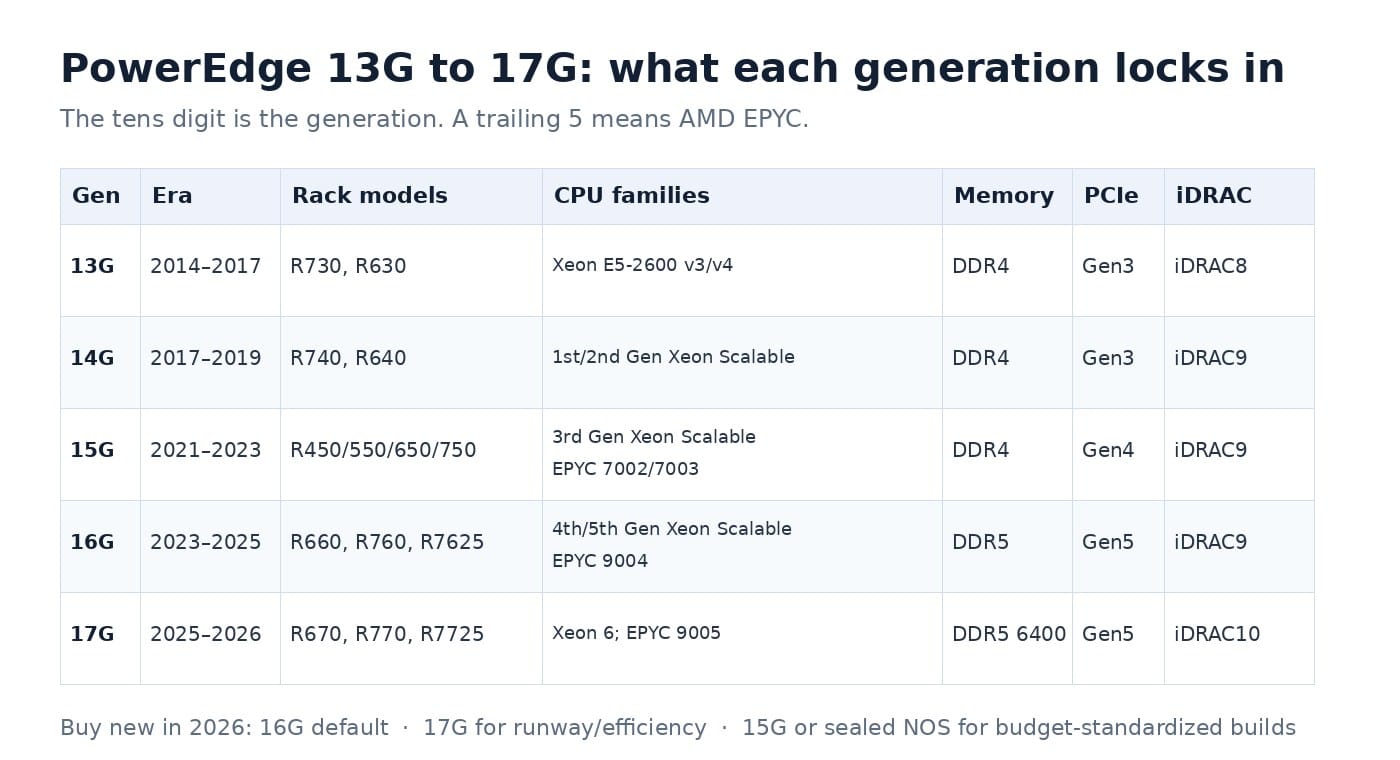
PowerEdge 13G–17G at a glance: which generation is which?
The tens digit in a Dell PowerEdge model name tells you the generation — R730 is 13G, R770 is 17G — and each generation locks in the CPU family, memory type and management controller.
If you need the full generation-by-generation reference — every rack model, release window and platform detail on one page — that is kept separately in Dell PowerEdge Generations Explained: 14G, 15G, 16G and 17G. This page stays on the decision.
| Gen | Era | Representative rack models | CPU families | Memory | PCIe | iDRAC |
|---|---|---|---|---|---|---|
| 13G | 2014–2017 | R730, R630 | Xeon E5-2600 v3/v4 | DDR4 | Gen3 | iDRAC8 |
| 14G | 2017–2019 | R740, R640 | 1st/2nd Gen Xeon Scalable | DDR4 | Gen3 | iDRAC9 |
| 15G | 2021–2023 | R450, R550, R650, R750 | 3rd Gen Xeon Scalable; EPYC 7002/7003 on AMD models | DDR4 | Gen4 | iDRAC9 |
| 16G | 2023–2025 | R660, R660xs, R760, R760xa, R7625 | 4th/5th Gen Xeon Scalable (up to 64 cores); EPYC 9004 | DDR5 | Gen5 (some Gen4) | iDRAC9 |
| 17G | Launched 2025 (R770 from June 2025) | R470, R570, R670, R770, R6725, R7725 | Intel Xeon 6 (up to 144 E-cores / 86 P-cores); EPYC 9005 (up to 192 cores) | DDR5 up to 6400 MT/s | Gen5 | iDRAC10 |
Two naming shortcuts let you read any quote at speed:
- The tens digit is the generation: R750 = 15G, R760 = 16G, R770 = 17G.
- A trailing 5 means AMD EPYC: R7625 and R7725 are the AMD counterparts of the R760 and R770, while R760 and R770 are Intel. The suffixes mean something too. `xs` is a value/dense variant, `xa` is GPU-focused, and `xd`/`xd2` is storage-dense.
Dell publishes the full generation mapping on its support site. When a refurbished or traded unit crosses your desk, confirm the service tag there instead of trusting a seller’s label.
In 2026, which PowerEdge generation should you actually buy new?
Buy 16G as the default for most projects, step up to 17G when platform life or efficiency justifies the premium, and use 15G or sealed stock only for deliberate, budget-driven builds.
| Position in 2026 | Generation | When it wins | When to avoid |
|---|---|---|---|
| Safe mainstream default | 16G (R660/R760) | Proven supply, mature pricing, DDR5 + Gen5, long usable runway | You specifically need Xeon 6 / iDRAC10 runway |
| Newest, longest runway | 17G (R670/R770/R7725) | Multi-year standardization, dense virtualization, efficiency, E3.S scale, future-proofing fleets | Tight budget; workload that cannot use the cores |
| Budget / standardized | 15G (R450/R550/R650/R750) | Price-sensitive, lighter workloads, short-to-mid life | Long support windows or DDR5/Gen5 requirements |
| Verified sealed NOS | Active-gen factory-sealed stock | Project margin on an active platform, verified condition | Unverified sellers; undocumented warranty |
The decision comes down to runway versus utilization. A server bought in 2026 will usually run three to five years. 17G stretches the supported, expandable life to the far end of that window. 16G covers the same workloads today at better pricing, and it already has a mature, well-understood parts ecosystem behind it.
What actually changes between 16G and 17G?
17G is a platform and efficiency generation — Xeon 6, EPYC 9005, iDRAC10 and faster DDR5 — not a reshuffle of the same servers under new names.
Using Dell’s official flagship 2U sheets as the anchor:
| Feature | R760 (16G, Intel) | R770 (17G, Intel) |
|---|---|---|
| Processors | Up to two 4th/5th Gen Xeon Scalable, up to 64 cores each | Two Intel Xeon 6, up to 144 E-cores or 86 P-cores each |
| Memory | 32 DDR5 RDIMM, up to 8 TB; up to 5600 MT/s (5th Gen) | 32 DDR5 RDIMM, up to 8 TB; up to 6400 MT/s |
| PCIe | Up to 8 slots, Gen5/Gen4 mix | Up to 8 Gen5 slots |
| Max front NVMe | Up to 16× E3.S Gen5 (plus 2.5-inch options) | Up to 32× E3.S Gen5 (up to 40 with rear option) |
| Boot | BOSS-N1 (2× M.2 NVMe) | BOSS-N1 DC-MHS |
| Management | iDRAC9 | iDRAC10 |
| Accelerators | Up to 2 double-width / 6 single-width | Up to 2 double-width (450 W) / 6 single-width |
| Cooling | Air; optional DLC | Air; optional DLC |
On the AMD side, the R7625 (16G, EPYC 9004) reaches up to 128 cores per processor on Dell’s reference materials. The R7725 (17G, 5th Gen EPYC 9005) reaches up to 192 cores, with 24 DDR5 DIMMs, up to 6 TB and up to 6400 MT/s per Dell’s official materials. If the project hinges on core density or per-core economics, the R7725 is the 17G headline. If current EPYC 9004 pricing is sharper and the workload fits, the R7625 is still genuinely competitive.
Here is what an integrator actually feels: higher core ceilings, better performance per watt, a newer management platform (iDRAC10), denser E3.S NVMe options, and the longest firmware/patch runway in the line. On a three-year refresh for ordinary VMs and line-of-business databases, much of that headroom sits unused. That is exactly why 16G stays the default.
When is paying up for 17G the right call?
Choose 17G when the platform will live long, run hot and dense, or anchor a standardized fleet — not just because it carries the newest label.
Pay up for 17G when several of these are true:
- You are standardizing a fleet for five years and want the longest update and parts runway.
- The project is dense virtualization, VDI, cloud-native or scale-out, where many efficient cores pay back.
- Power and rack density are constrained, and performance per watt materially changes the rack count.
- You need the densest E3.S NVMe configurations or the newer iDRAC10 management feature set.
- The customer’s roadmap already assumes Xeon 6 / EPYC 9005 certification.
Stay on 16G when the workload is mainstream, the budget is firm, the term is three years, or the customer cannot consume extra cores. One caution: per-core database licensing can erase a “cheap cores” advantage fast.
When do 15G or factory-sealed NOS make sense?
15G and verified sealed stock are procurement tools for defined budgets and shorter lives, not compromises to hide from a customer.
- 15G new or active stock (R450/R550/R650/R750): solid DDR4/Gen4 platforms for lighter virtualization, file/print, branch and midlife projects. Note that the entry 1U R450 and 2U R550 are 3rd Gen Xeon Scalable DDR4 platforms: on Dell’s official sheets the R550 tops out at 24 cores per socket, 16 DDR4 RDIMMs and 1 TB of memory. They are capable machines, but not five-year flagships.
- Factory-sealed new-old-stock: unused, never-deployed, sealed units from an active generation can land a project at better margin. It is defensible only with sealed packaging, serial numbers you can reconcile, written warranty terms (servers vs storage vs parts), and a supplier that can still provide matching spares years later.
- Used/refurbished: a separate, lower-tier decision for cost-driven or short-life builds, typically with around one-year terms per contract — never presented as new.
Honest condition labeling and written terms are what separate a legitimate NOS deal from grey-market risk. As an independent supplier and exporter, we quote condition and coverage on that transparent basis. If the same project also involves direct procurement from China, the import and payment side is a separate buying servers from China workflow worth checking before you commit.
Which mainstream R-series model fits which job?
Match the chassis to the workload before you compare prices inside a generation.
| Model | Form factor | Position | Typical fit |
|---|---|---|---|
| R450 | 1U dual-socket (15G) | Entry, value | Branch, light VMs, small infra |
| R550 | 2U dual-socket (15G) | Versatile value | File, surveillance, small business IT |
| R660xs | 1U dual-socket (16G) | Compact/dense value | Dense general compute, 1U VMs; 16 DIMMs, ~1.5 TB ceiling on Dell’s sheet |
| R660 | 1U dual-socket (16G) | Full-featured 1U | High-density virtualization, 32 DIMMs, up to 8 TB |
| R760 | 2U dual-socket (16G) | Mainstream flagship | Most enterprise VMs, databases, mixed workloads |
| R760xa | 2U dual-socket (16G) | GPU-focused | AI/ML inference and graphics; up to 4 double-width PCIe Gen5 accelerators |
| R770 | 2U dual-socket (17G) | Newest flagship Intel | Long-life standardization, dense VMs, AI inference, E3.S scale |
| R7725 | 2U dual-socket (17G) | Newest flagship AMD | Highest core density, scale-out, dense virtualization |
For a typical VMware/Hyper-V/Proxmox cluster, the R760 class is the workhorse. Move to the R660/R670 class when rack units are the constraint. When GPUs drive the design, use the R760xa or a dedicated XE platform. Entry branch work rarely needs more than an R450/R550 class.
Do parts stay compatible across generations — and how do you confirm?
Within a generation, the parts ecosystem is consistent; across generations, PSUs, RAID controllers, NICs and RAID batteries move, so verify every part number against the exact model instead of assuming.
A 15G PERC H755, a 16G/17G H965i/H975i and the BOSS boot devices are not interchangeable by intuition. PSU wattages and form factors also shift by chassis and generation; mainstream 16G/17G systems run 800 W up to 3200 W Titanium options on Dell’s official sheets. Before you standardize a fleet, confirm the PSU, NIC, RAID and memory you plan to keep on the shelf are valid for the exact model. Use our PowerEdge compatibility center and part-number lookup, and browse the Dell PowerEdge parts and spares for generation-specific parts.
Request a quote for the right generation
The generation call is a commercial decision, not just a technical one: workload life, licensing, parts runway and budget together decide whether 15G, 16G, 17G or sealed NOS is right. Send us your workload, target generation and quantities, and we will review the fit before you commit. See the current PowerEdge line new and factory-sealed NOS PowerEdge servers and the Get-a-Quote. All orders ship from China with worldwide delivery, with lead time and warranty terms fixed per contract.
Frequently Asked Questions
What is the newest Dell PowerEdge generation in 2026?
The newest is the 17th generation (17G), which launched in 2025, with the R770 shipping from June 2025. It includes the Intel-based R470, R570, R670 and R770 (Intel Xeon 6, iDRAC10) and the AMD-based R6725 and R7725 (5th Gen EPYC 9005). The 16th-generation R660/R760 family remains on the market as the mainstream, mature-priced choice.
Should I buy 16G or 17G PowerEdge for a new deployment?
Buy 17G when you need the longest support runway, high core density, better performance per watt or dense E3.S NVMe in a long-life fleet. Buy 16G for mainstream virtualization and databases on a typical three-year horizon: its DDR5/Gen5 platform already covers the workload, and the pricing is sharper.
Is the Dell PowerEdge R760 still worth buying new in 2026?
Yes. Per Dell’s official sheet, the R760 runs dual 4th/5th Gen Xeon Scalable processors, 32 DDR5 RDIMMs up to 8 TB, PCIe Gen5 slots, broad NVMe and up to two double-width GPUs. It remains a capable mainstream 2U flagship with mature supply and parts, and it is the default choice unless you specifically need the 17G runway.
Which PowerEdge model is best for SQL Server or GPU work?
For databases, the typical answer is a 2U dual-socket with strong per-core performance, ample RDIMM and low-latency NVMe — the R760 class today, the R770 for longest life — subject to the database vendor’s certification and per-core licensing. For GPU/AI work, use the GPU-focused R760xa (up to four double-width PCIe Gen5 accelerators) instead of forcing cards into a general chassis; at 8-GPU scale, move to a dedicated XE platform.
What warranty and condition terms should an integrator expect?
Brand-new servers are typically quoted with roughly three-year terms per supplier policy and contract; storage systems and spare parts often fall under a separate one-year supplier policy, and used equipment around one year, all fixed per contract. Verify factory sealing and serials on new-old-stock, get terms in writing, and do not assume a manufacturer’s official local warranty unless it is documented. Orders ship from China with worldwide delivery.

WeChat
Scan the QR Code with wechat