 serverbastion.com

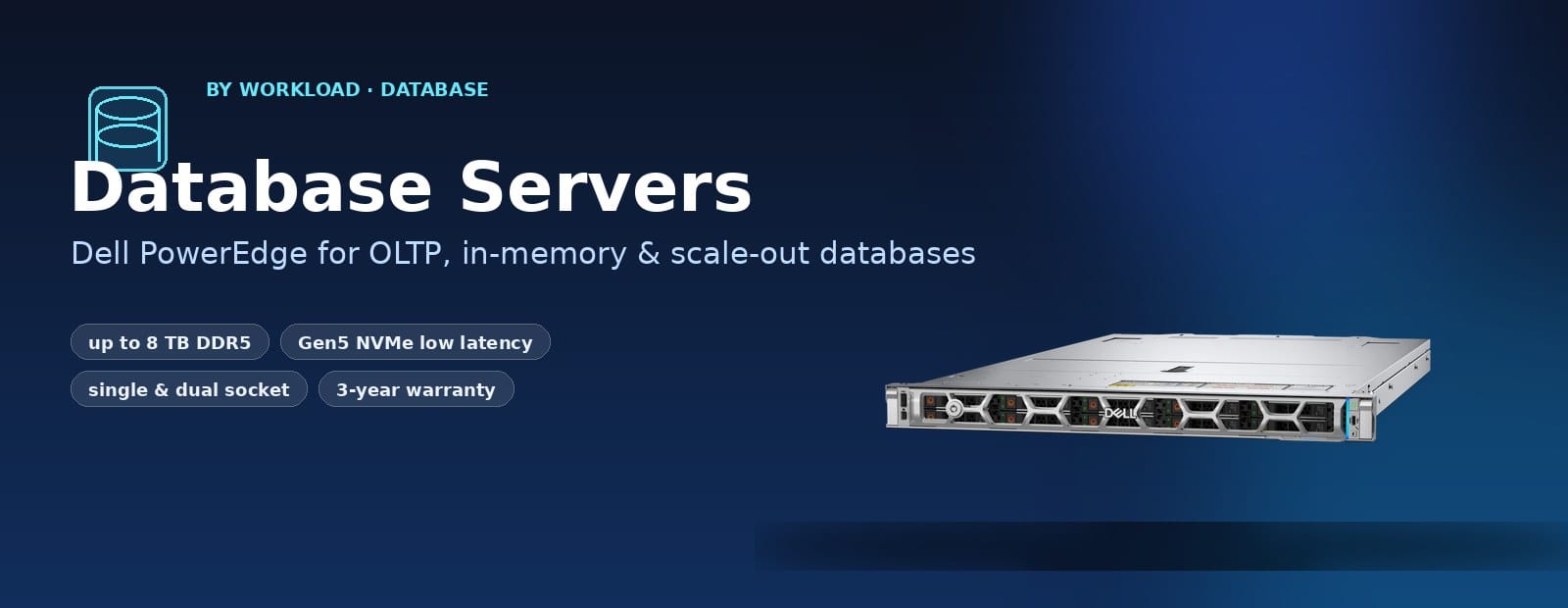
Database Servers — Dell PowerEdge for OLTP, In-Memory & Scale-Out
Database performance is decided by three things: enough memory to keep the working set hot, Gen5 NVMe that keeps redo and data latency low, and cores that survive peak concurrency. These brand-new 17th-generation PowerEdge rack servers are configured for exactly that, across both the Intel Xeon and AMD EPYC lineups — from single-socket value nodes to dual-socket in-memory hosts with up to 8 TB of DDR5.
Match the server to your database workload
High-concurrency transaction systems
ERP, order management, billing and line-of-business apps that live or die on low commit latency and fast random reads. Prioritise Gen5 NVMe for data and redo, strong per-core speed and redundant power.
- R770
- R670
- R7725
- R6725
Large RAM-footprint databases
In-memory engines, real-time analytics and large buffer pools benefit from the highest memory ceilings — up to 8 TB on the dual-socket Intel platforms and 6 TB on the EPYC platforms.
- R770 (8 TB)
- R670 (8 TB)
- R7725 (6 TB)
- R7715 (6 TB)
Distributed & scale-out databases
Sharded and shared-nothing clusters that multiply by the node: single-socket servers keep licensing and per-node cost low while still delivering dense cores and direct-attached NVMe.
- R570
- R7715
- R470
- R7725xd
Cost-optimised standalone hosts
Smaller production databases, reporting and departmental SQL on a single socket — one processor to license, up to 4 TB of memory, and the same Gen5 NVMe and 3-year warranty as the dual-socket range.
- R570 (2U)
- R470 (1U)
- R7715
Database servers compared
Maximum figures per the Dell official specification sheets; your exact build is matched to workload and budget.
| Model | Form factor | Sockets | Max memory | Max cores (total) | Gen5 NVMe |
|---|---|---|---|---|---|
| R770 | 2U rack | Dual Intel Xeon 6 | 8 TB DDR5 · 6400 | 288 (2×144 E) | Up to 44 × E3.S |
| R670 | 1U rack | Dual Intel Xeon 6 | 8 TB DDR5 · 6400 | 288 (2×144 E) | Up to 20 × E3.S |
| R7725 | 2U rack | Dual AMD EPYC 9005 | 6 TB DDR5 · 6400 | 384 (2×192) | Up to 40 × E3.S |
| R6725 | 1U rack | Dual AMD EPYC 9005 | 6 TB DDR5 · 6400 | 384 (2×192) | Up to 20 × E3.S |
| R7715 | 2U rack | Single AMD EPYC 9005 | 6 TB DDR5 · 5200 | 160 | Up to 40 × E3.S |
| R7725xd | 2U rack | Dual AMD EPYC 9005 | 6 TB DDR5 · 6400 | 384 (2×192) | Up to 24 × U.2 |
| R570 | 2U rack | Single Intel Xeon 6 | 4 TB DDR5 · 6400 | 144 E / 86 P | Up to 36 × E3.S |
| R470 | 1U rack | Single Intel Xeon 6 | 4 TB DDR5 · 6400 | 144 E / 86 P | Up to 18 × E3.S |
Choose by memory ceiling
The largest in-memory and buffer-pool footprint, on 32 DDR5 DIMMs at 6400 MT/s.
- Dual-socket Intel platforms
- R770 (2U) · R670 (1U)
- In-memory engines & large analytics
Dense EPYC memory on 24 DIMMs, with the highest core counts for concurrent sessions.
- R7725 · R6725 · R7725xd (6400)
- R7715 single socket (5200)
- Up to 384 cores (dual)
Single-socket Intel value nodes that keep software licensing to one processor.
- R570 (2U) · R470 (1U)
- 16 DDR5 DIMMs · 6400
- Up to 144 E-cores
How storage is configured for databases
NVMe for data & redo
Gen5 EDSFF E3.S or U.2 NVMe is used for the data files and redo/WAL so commits and checkpoints stay off spinning media; RAID or direct-attach layouts follow your engine’s guidance.
Separate BOSS boot
The operating system runs on dual M.2 NVMe behind a BOSS-N1 boot controller, keeping the OS independent of the data drives and simplifying reinstalls and recovery.
Room to grow
RDIMM capacity and front NVMe bays are populated to your spec today and left expandable, so buffer pools and storage can scale without replacing the chassis.
How these servers are supplied
Brand-new condition
All units are current 17th-generation Dell PowerEdge rack servers, new and sealed — no used or refurbished parts are substituted.
Assembly & testing
Drives, memory and controllers are fitted to your build, then the server is burned in and stress-tested before it leaves our facility.
3-year warranty
Every server ships with a 3-year warranty backed by Beijing Xinchuan Technology Co., Ltd., plus documented test reports.
Configure a database server for your workload
Tell us your database engine, dataset size and concurrency targets — we’ll recommend the platform, memory and NVMe layout and quote within one business day.
Frequently asked questions
Which PowerEdge is best for a high-transaction OLTP database?
A dual-socket 2U platform such as the R770 (Intel) or R7725 (AMD) gives the best balance of fast cores, Gen5 NVMe for data and redo, and memory headroom for peak concurrency. The 1U R670 and R6725 offer the same memory ceilings where rack space is tight.
What is the maximum memory available for an in-memory database?
The dual-socket Intel R770 and R670 support up to 8 TB of registered ECC DDR5 across 32 DIMM slots. The AMD EPYC R7725, R6725, R7725xd and R7715 support up to 6 TB.
Are single-socket servers suitable for production databases?
Yes. The R570 and R470 support up to 144 E-cores and 4 TB of memory, and the single-socket layout means only one processor licence is required — ideal for smaller production instances and scale-out nodes.
How is NVMe storage arranged for database workloads?
Gen5 E3.S or U.2 NVMe is used for data files and redo/WAL, while the OS runs on separate dual-M.2 BOSS-N1 boot media. RAID versus direct-attached NVMe is configured to match your database engine’s recommendations.
What is the difference between the E3.S and U.2 NVMe form factors?
Both run Gen5 NVMe; EDSFF E3.S is the newer, denser format used across most 17G servers, while U.2 is the familiar 2.5-inch bay used on storage-dense models such as the R7725xd (up to 24 × U.2).
What warranty and lead time apply?
These brand-new servers carry a 3-year warranty and are supplied with test documentation. Configured builds are typically quoted within one business day, with lead time confirmed at order based on the exact memory and drive specification.
Which database engines and operating systems do you support?
The range runs the common enterprise stacks — Microsoft SQL Server, Oracle Database, PostgreSQL, MySQL/MariaDB, SAP HANA and NoSQL engines such as MongoDB — on Windows Server or Linux (RHEL, SLES, Ubuntu). We match CPU, memory and storage to your engine and version; database and OS licences are supplied by you unless agreed separately.
Should I use hardware RAID or direct-attached NVMe?
It depends on the engine. Many modern databases prefer direct-attached (JBOD) NVMe so the database or a redundant array manages replication at lowest latency, while others use hardware RAID for a small set of data or log drives. We configure the controller in HBA or RAID mode to match your documented best practice and can advise per workload.
How should I configure for high availability or a clustered database?
Database HA is built with redundant nodes plus shared or replicated storage and redundant networking. We can supply matched, identically configured hosts with dual power, multiple NICs/HBAs and the same BIOS and firmware baseline, plus (where used) a shared-storage array, so Always On, Data Guard, replication or clustering works predictably.
Which memory type should I choose — RDIMM or 3D RDIMM?
RDIMMs are the standard choice for most database hosts and deliver full capacity at lower cost. High-capacity 3D RDIMMs (up to 128 GB per module) are used to reach the largest memory footprints in fewer slots, suiting in-memory and very large buffer-pool workloads. We size rank, speed and population so all channels run at full speed.
Can you help with licensing and a validated configuration?
We do not resell most database licences, but we do size the hardware correctly for your licence model — including per-core and per-socket implications — and follow the vendor’s published sizing and supported-hardware guidance. Send your engine, version, user or core counts and growth plan and we return a matched, defensible configuration in writing.

WeChat
Scan the QR Code with wechat