 serverbastion.com

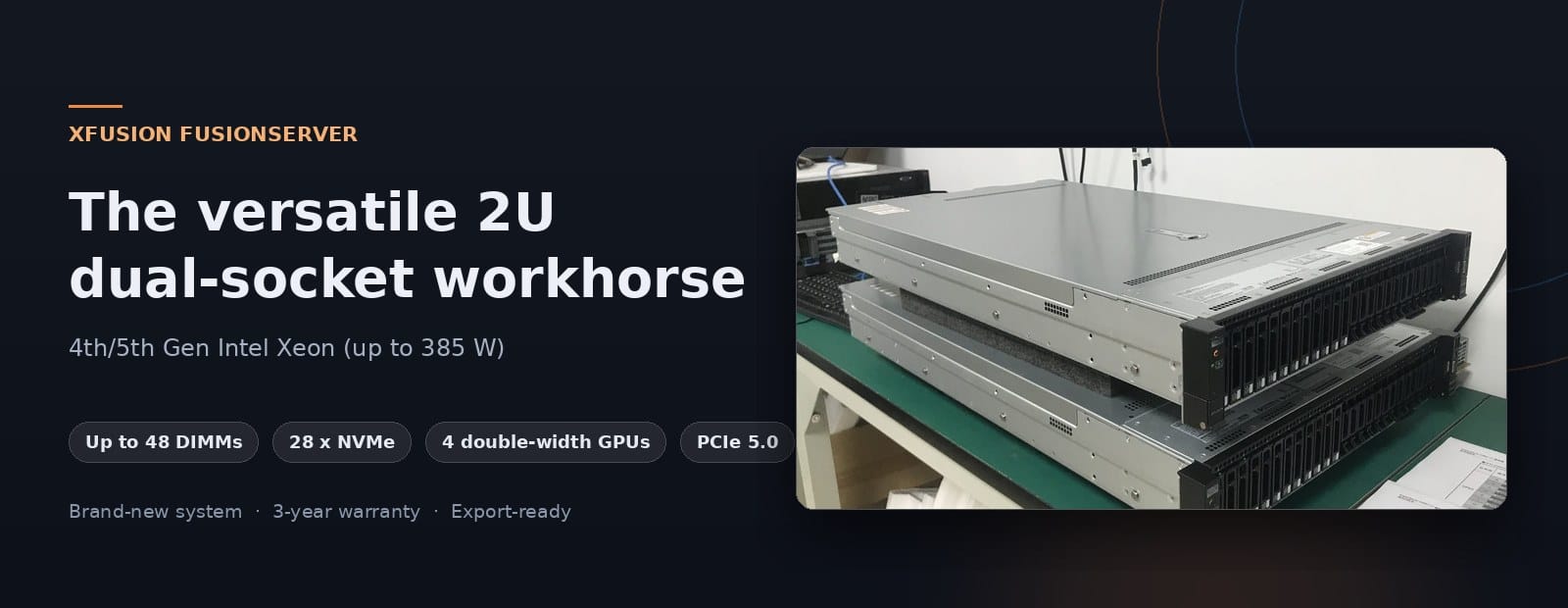
● BRAND-NEW · FUSIONSERVER V7
xFusion FusionServer 2288H V7: The Versatile 2U Dual-Socket Workhorse
The FusionServer 2288H V7 is xFusion’s high-volume 2U, two-socket rack server, built on 4th- or 5th-Generation Intel Xeon Scalable processors with DDR5 memory, PCIe 5.0 expansion and a huge choice of NVMe, SAS and SATA configurations. It is the one chassis we recommend when a workload — virtualization, database, big data, VDI or AI inference — needs headroom without the cost of a specialized platform. We supply it as a brand-new system, configured to order, with a 3-year warranty.
One platform for a long list of workloads
xFusion positions the 2288H V7 as a general-purpose enterprise and telecom server. Its balance of cores, memory channels and storage density makes it equally at home in software-defined infrastructure and in classic three-tier applications.
Database & virtualization
OLTP, in-memory databases and dense VM hosts benefit from up to 48 DIMMs, eight memory channels and low-latency NVMe.
Big data & SDS
Up to 45 hot-swap 2.5-inch drives or 18 large-form-factor drives give Hadoop, object storage and SDS nodes real capacity in 2U.
VDI & cloud
Host many desktop and cloud instances with flexible OCP 3.0 networking and optional single- or double-width accelerators.
AI inference & CDN
Up to four double-width or fourteen single-width accelerator cards support inference, transcoding and edge-content workloads.
FusionServer 2288H V7 at a glance
Figures below follow the official xFusion technical specifications. Maximums sometimes require a specific riser, backplane or power configuration — we confirm the exact build before quoting.
| Specification | FusionServer 2288H V7 |
|---|---|
| Form factor | 2U rack server, 86.1 × 447 × 798 mm (H × W × D) |
| Processors | 1 or 2 × 4th- or 5th-Generation Intel Xeon Scalable, TDP up to 385 W per processor |
| Chipset | Intel Emmitsburg PCH |
| Memory | 32 × DDR5 DIMMs at up to 5600 MT/s, plus 16 DIMMs through CXL — up to 48 DIMMs total |
| Local storage | 8–35 × 2.5-inch SAS/SATA/SSD; up to 45 × 2.5-inch drives or 28 × all-NVMe; 12–18 × 3.5-inch drives; 4/8/16/24 × NVMe; 2 × M.2 SSD |
| RAID | RAID 0, 1, 10, 1E, 5, 50, 6, 60 with optional supercapacitor cache protection |
| PCIe expansion | Up to 19 slots: 2 FlexIO slots for OCP 3.0 NICs plus 17 standard slots, 8 of them PCIe 5.0 |
| Accelerators | Up to 4 double-width or 14 single-width GPU/accelerator cards |
| Networking | Dual FlexIO slots for hot-swap OCP 3.0 adapters, configurable by speed and port count |
| Cooling & power | 4 hot-swap counter-rotating fans in N+1 redundancy; 900 W–3000 W Platinum/Titanium PSUs in 1+1 redundancy |
| Management | iBMC with dedicated GE management port; Redfish, SNMP, IPMI 2.0, HTML5/VNC KVM; optional FusionDirector |
| Security & environment | TPM 2.0, secure boot, security bezel, chassis intrusion detection; 5°C to 50°C operating temperature |
What the platform delivers under load
The figures below are spec-derived ceiling values from the processor, memory and PCIe architecture, not benchmark scores. Real throughput depends on the CPU SKU, workload, DIMMs, drives and networking you choose — we size the build against your target and verify it in testing.
Memory bandwidth
Eight DDR5-5600 channels per socket give a theoretical peak of roughly 358 GB/s per socket — about 716 GB/s on a dual-CPU board — for in-memory and memory-bound databases.
Flash throughput
Gen5 NVMe drives run at up to about 14 GB/s each; with up to 28 front NVMe bays an all-flash build can sustain very high aggregate IOPS for hot data and redo/WAL.
I/O bandwidth
Eight PCIe 5.0 slots — a x16 link moves roughly 63 GB/s per direction — feed GPUs and fast adapters without the bottlenecks of older generations.
Network & compute
Dual hot-swap OCP 3.0 adapters support up to 100/200 GbE-class connectivity, alongside up to 385 W per CPU and four double-width accelerators.
A closer look at the hardware
These photographs are of an actual FusionServer 2288H V7 we configured and inspected, not manufacturer renderings.
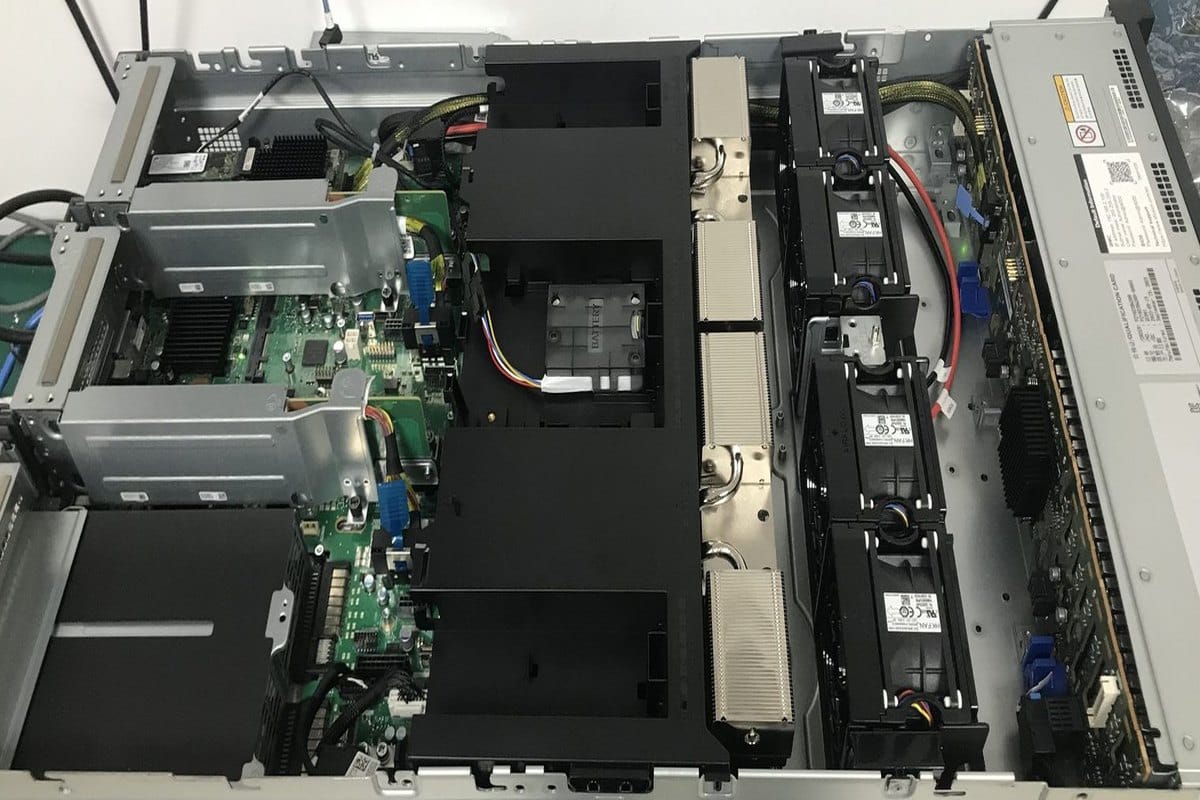
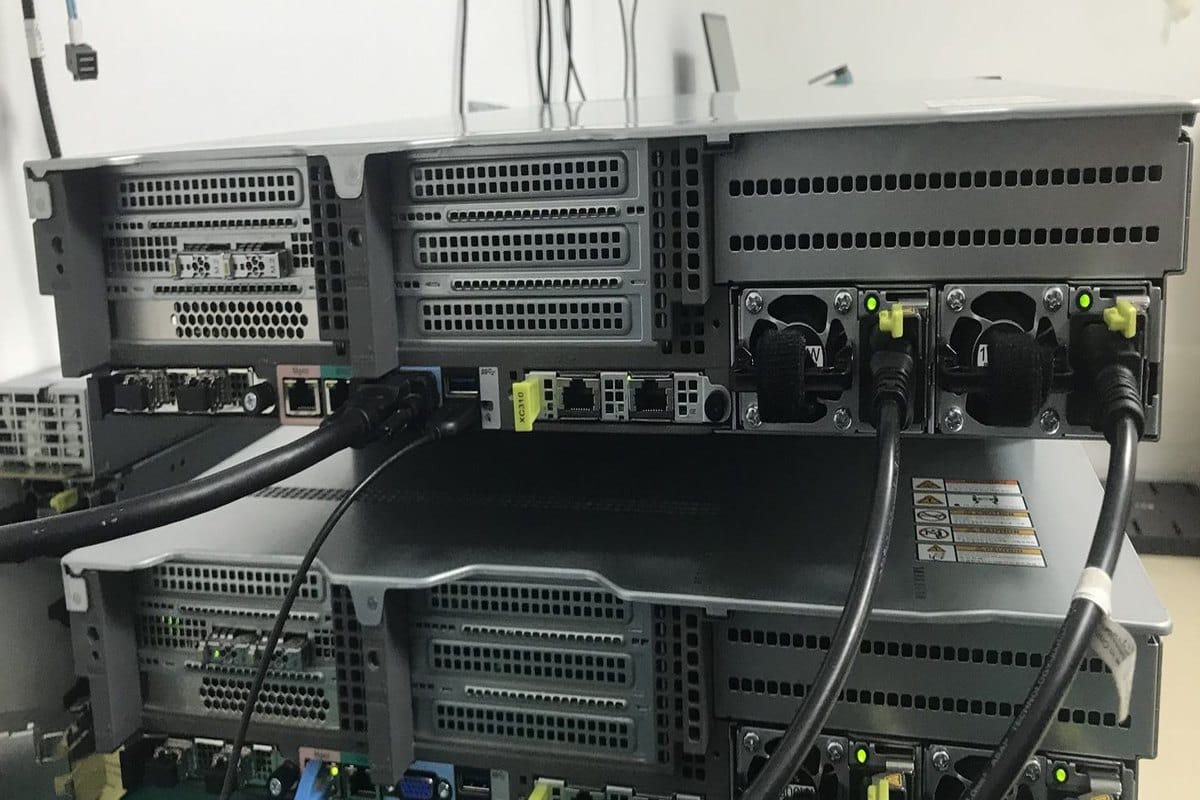
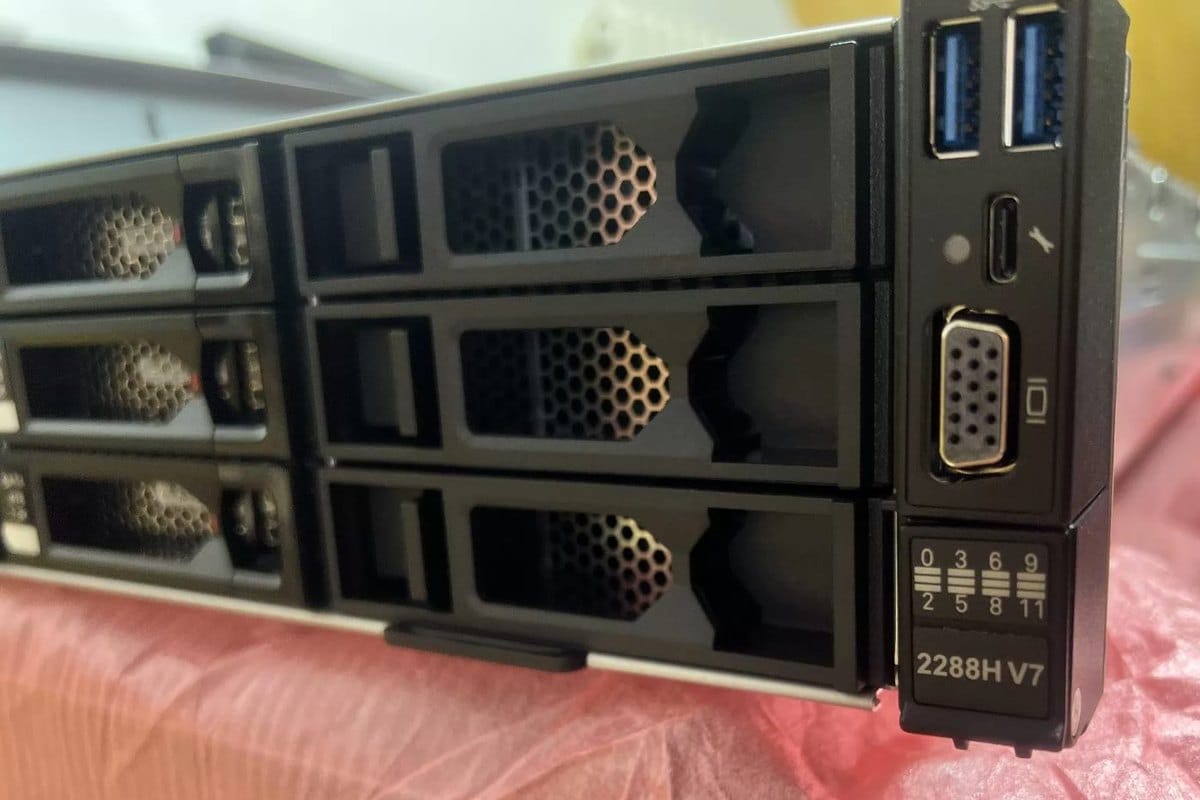
The front bays accept SAS, SATA and NVMe devices depending on the backplane selected, so the same chassis can be a cost-heavy storage node with large drives or an all-flash, low-latency database server. Two internal M.2 SSDs provide a hardware-RAID boot volume that keeps the front bays free for data.
For comparison with our Dell line, see how this class of machine lines up on the Intel Xeon servers page, or browse accelerator-ready builds on the GPU servers page.
Three common ways we configure it
Virtualization and transactional database
Dual processors, a full bank of DDR5 RDIMMs and 8–24 front NVMe drives give VM hosts and OLTP databases both memory capacity and low storage latency. This is our most frequent build.
Big data and software-defined storage
Choose the high-drive-count backplane — up to 45 × 2.5-inch or 18 × 3.5-inch drives — for distributed storage, backup and analytics nodes where terabytes matter more than all-flash speed.
VDI, inference and accelerated services
Add up to four double-width accelerators and high-speed OCP 3.0 networking for desktop farms, AI inference, transcoding and other GPU-assisted workloads, with high-wattage PSUs to match.
Every server is checked before it ships
Quality is built into how we prepare an order, not just the warranty. Each 2288H V7 goes through a defined inspection and burn-in process at our facility, and any unit that does not pass is corrected before dispatch — never shipped “as is”.
Authentic, new components
We verify the chassis, CPUs, memory, drives and adapters are genuine and brand-new, with serial numbers and the exact configuration recorded against the order.
Assembly & firmware
CPUs, heatsinks, DIMMs, RAID and OCP adapters are seated to torque and the latest tested BIOS, iBMC and RAID firmware are applied before testing.
Power-on & POST checks
Every system completes a full POST; memory training, CPU presence, fan and PSU status and sensor readings are checked for warnings or faults.
Burn-in stress test
The configured build runs an extended load and thermal cycle at high utilization to confirm stability, temperatures and that throttling does not occur.
Storage & RAID validation
Each drive is recognized and tested, RAID arrays and cache protection are verified, and boot plus data volumes are confirmed end to end.
Final QC & export packing
A second technician signs off the configuration and test record, then the unit is cleaned and packed for safe international transport with full documentation.
Tested, documented, warranted. A test record accompanies every build and the 3-year warranty starts only after the unit passes final QC. If anything fails in service, our team supports remote diagnosis and replacement parts through the warranty terms.
A proven server maker, not an unknown name
Some buyers compare xFusion with Dell and ask whether the brand is established enough to trust with production workloads. xFusion is a large, independent server manufacturer with a documented engineering heritage and carrier-grade deployments, so the platform behind this 2288H V7 is built and supported at enterprise scale.
Built on a server heritage
xFusion was formed in 2021 from the x86 server business, retaining the engineering team and continuing the FusionServer line; it is an independent company, not a new assembler.
Top-tier market position
According to IDC, xFusion ranks among the leading x86 server vendors in China and within the top tier globally, with the scale that implies for supply and support.
Deployed worldwide
xFusion reports business in more than 100 countries, serving over 10,000 customers with a large global partner ecosystem across telecom, cloud and enterprise.
Trusted at carrier scale
Major telecom operators, internet and cloud companies run FusionServer at scale, and the platform is certified with leading accelerator and component ecosystems.
xFusion vs Dell: how to choose
Both are legitimate enterprise server brands using Intel Xeon platforms; the difference is fit and total cost, not whether the hardware is “real” enterprise gear.
| Factor | xFusion FusionServer | Dell PowerEdge |
|---|---|---|
| Platform | Intel Xeon (4th/5th Gen), standard DDR5, PCIe 5.0 and OCP 3.0 in a chassis engineered for high-density data centers. | Intel Xeon platforms with a long on-premises track record and a broad global install base. |
| Best fit | Cost-conscious data-center, virtualization, telecom and bulk deployments where channel pricing and density matter. | Organizations standardized on Dell or needing the widest on-site service footprint in every region. |
| Price / value | Typically a more competitive channel price for equivalent Intel specifications, which lowers capital cost at quantity. | Premium pricing in many markets, partly reflecting brand and support reach. |
| Warranty & support | 3-year warranty on the new systems we supply, with our configuration, burn-in and export support included. | Dell factory support options, availability varies by country and contract. |
Our honest take: if you already operate Dell under a global support contract, staying on Dell is reasonable. If you want the same current Intel platform at a better channel price for a project or fleet, xFusion is an established brand we configure, test and back with a 3-year warranty — not a gamble on an unknown vendor.
Backed by warranty, tested and export-ready
Warranty on a new server
Every 2288H V7 we ship is a brand-new system covered by a 3-year warranty, with configuration and burn-in handled by Beijing Xinchuan Technology Co., Ltd. before dispatch.
Redundant power and cooling
Dual PSUs in 1+1 redundancy and four N+1 counter-rotating fans keep the system running through a component or fan-module failure.
Fast quotation, export experience
Tell us the workload and quantity and we normally return a configured quote within one working day, with export documentation and logistics arranged as needed.
Configure your FusionServer 2288H V7
Send us your CPU, memory, storage and accelerator requirements — or simply describe the workload — and we will come back with a tested build and a channel price.
FusionServer 2288H V7 questions
What is the FusionServer 2288H V7?
It is xFusion’s mainstream 2U, two-socket rack server powered by 4th- or 5th-Generation Intel Xeon Scalable processors. It is designed for general enterprise and telecom workloads such as virtualization, database, big data, SDS, VDI, CDN and AI inference, and is one of the highest-volume 2U models in the FusionServer range.
How many CPUs and what TDP does it support?
The 2288H V7 accepts one or two 4th- or 5th-Generation Intel Xeon Scalable processors, with a TDP of up to 385 W per processor. A single-CPU build is available for cost-sensitive, lightly threaded workloads; most production configurations use two processors.
What is the maximum memory configuration?
The standard board provides 32 DDR5 DIMM slots running at up to 5600 MT/s. Using CXL memory expansion, up to 16 additional DIMMs are supported, for a total of up to 48 DIMMs. The exact capacity depends on the DIMM sizes chosen and the processor generation.
How many drives and NVMe devices can it hold?
Depending on the backplane, it supports 8 to 35 hot-swap 2.5-inch SAS/SATA/SSD drives (up to 45 in the maximum configuration, or 28 all-NVMe SSDs), 12 to 18 3.5-inch drives, and 4, 8, 16 or 24 NVMe SSDs. Two M.2 SSDs provide a separate hardware-RAID boot volume.
Can the 2288H V7 take GPU accelerators?
Yes. With the appropriate risers and power supply it supports up to four double-width accelerator cards or up to fourteen single-width cards, which is why it commonly serves VDI, AI inference and transcoding as well as general compute.
How do you test each server before shipment?
Every build goes through component verification, assembly and firmware checks, full POST diagnostics, an extended high-utilization burn-in, storage and RAID validation, and a final independent QC sign-off. A test record accompanies the order and the 3-year warranty starts only after the unit passes, so no system ships untested.
How do you guarantee the performance I need?
We start from your workload and performance target, select a CPU, memory, storage and networking configuration that meets it with headroom, and then confirm stability and thermal behavior during burn-in. The throughput figures on this page are spec-derived ceilings; actual results depend on your application, which is why we size and verify the build rather than quote generic benchmark numbers.
What warranty, lead time and condition apply?
We supply the 2288H V7 as a brand-new server with a 3-year warranty, configured and tested before shipment. Quotations are normally provided within one working day and lead time depends on the CPU and storage selected; export packaging and documentation are arranged for international orders. Read more on our warranty page.
Is xFusion as reliable as Dell?
Yes — xFusion is a large, independent server maker formed from the original x86 server business, ranked by IDC among the leading x86 vendors globally and deployed at scale by major telecom, cloud and enterprise customers in 100+ countries. Both brands use current Intel Xeon platforms; the practical difference is price, density and support fit rather than enterprise credibility. The new systems we supply carry a 3-year warranty and are burn-in tested before shipment.

WeChat
Scan the QR Code with wechat