 serverbastion.com

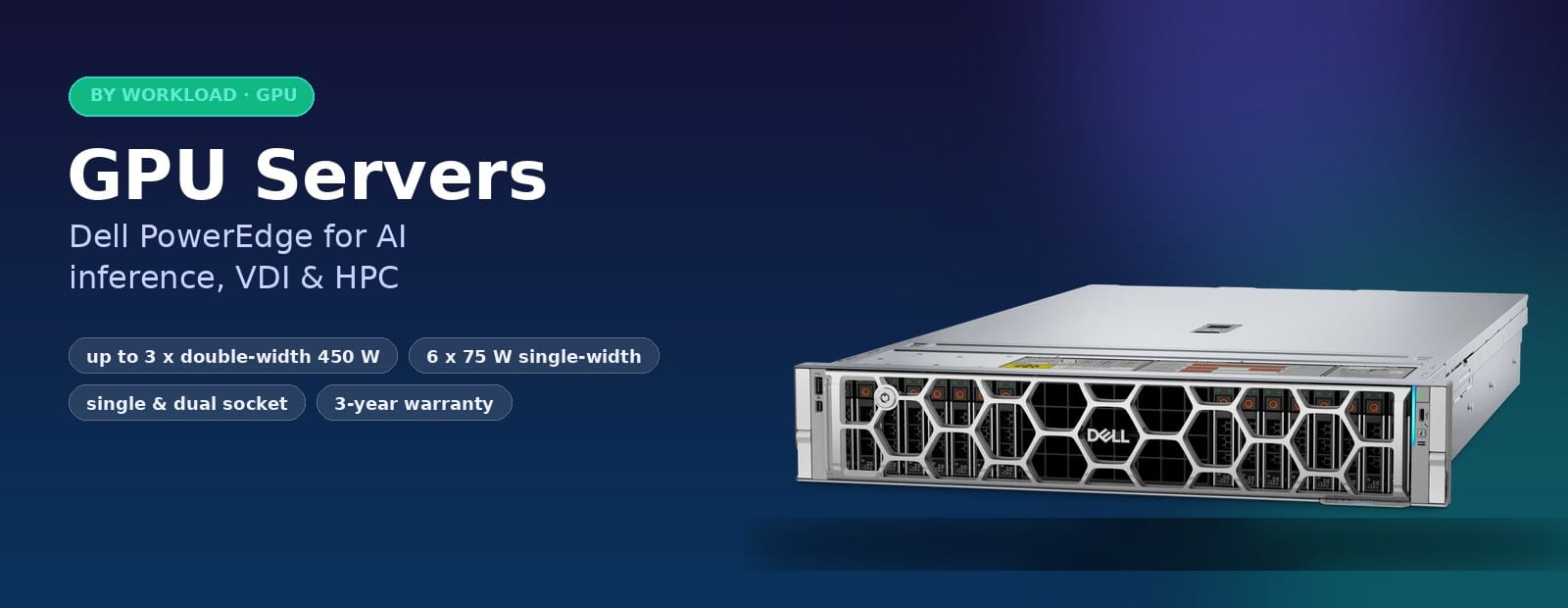
GPU Servers — Dell PowerEdge & xFusion for AI, Training, VDI & HPC
A practical guide to GPU-ready Dell PowerEdge rack servers we supply brand new on the 17G platform, across both the Intel Xeon and AMD EPYC lines. Whether you need a few low-profile inference cards or a 2U node with multiple double-width accelerators, every configuration below is built, validated and burn-in tested before dispatch and covered by a 3-year warranty. For larger models, xFusion’s 4U FusionServer nodes fit up to ten double-width accelerators in a single air-cooled chassis.
Choose by workload
Which GPU server fits the job?
Large-model serving & generative AI
Two or three 450 W double-width full-length accelerators (such as NVIDIA H200 NVL, L40S or A16) in a 2U chassis, with the PCIe lanes, power and cooling to sustain continuous inference.
Virtual desktops at scale
Up to six 75 W-class single-width cards (NVIDIA L4 72 W or A2) delivering a high density of user sessions without the power budget of double-width GPUs.
Single-width inference in 1U
Three single-width 75 W accelerators in a dense 1U form factor for edge inference, video transcode and lightweight ML where rack depth and space are tight.
GPU servers compared
Accelerator capacity across the range
| Model | CPU line | Form factor | Double-width GPUs | Single-width GPUs |
|---|---|---|---|---|
| R7715 | Single AMD EPYC | 2U | Up to 3 × 450 W | Up to 6 × 75 W |
| R770 | Dual Intel Xeon 6 | 2U | Up to 2 × 450 W | Up to 6 × 75 W |
| R7725 | Dual AMD EPYC | 2U | Up to 2 × 450 W | Up to 6 × 75 W |
| R470 | Single Intel Xeon 6 | 1U | — | Up to 4 × 75 W |
| R570 | Single Intel Xeon 6 | 2U | — | Up to 4 × 75 W |
| R670 | Dual Intel Xeon 6 | 1U | — | Up to 3 × 75 W |
| R6715 | Single AMD EPYC | 1U | — | Up to 3 × 75 W |
| R6725 | Dual AMD EPYC | 1U | — | Up to 3 × 75 W |
xFusion dense GPU nodes
FusionServer G5200 & G5500 — up to 10 GPUs in 4U
When a 2U node is not enough, xFusion’s 4U accelerated servers carry many double-width GPU cards in a single air-cooled, serviceable chassis, with redundant power, hot-swap fans and hardware RAID. Each is configured to order, burn-in tested and covered by a 3-year warranty.
xFusion FusionServer G5200 V7
Flexible 4U accelerator server with two 4th/5th-Generation Intel Xeon Scalable CPUs and a switchable riser topology for dense inference, training, VDI and HPC.
xFusion FusionServer G5500 V7
Flagship AI node with two 5th-Generation Intel Xeon Scalable (Emerald Rapids) CPUs, DDR5 and up to ten high-TDP dual-width accelerators (cascaded), or eight on the balanced PCIe x32 topology.
xFusion FusionServer G5500 V6
Proven 4U platform with two 3rd-Generation Intel Xeon Scalable (Ice Lake) CPUs, DDR4 and up to eight double-width cards at an attractive platform cost.
Accelerator tiers
Validated cards, grouped by use case
Double-width · 450 W
Large inference & training-adjacent
- NVIDIA H200 NVL 141 GB (capped at 450 W)
- NVIDIA L40S 48 GB
- NVIDIA H100 NVL 94 GB (350 W)
- NVIDIA A16 64 GB (250 W)
Single-width · 75 W class
VDI, transcode & edge inference
- NVIDIA L4 24 GB (72 W)
- NVIDIA A2 16 GB
- NVIDIA A10 / T4 class where required
- Up to six cards per 2U node
How we size a node
Power, risers & thermal
- Double-width cards need matching riser configs and 3200 W-class PSUs
- HPR Platinum fans required for top-tier GPUs
- We confirm OS/driver support (ESXi, Ubuntu, Windows) before build
Condition
Brand-new, current-generation 17G PowerEdge servers sourced through our independent supply channel — no used or refurbished parts in these builds.
Assembly & testing
Each GPU node is assembled to spec, firmware aligned and put through a full burn-in with the accelerators under load before it leaves our facility.
Warranty
Backed by a 3-year warranty provided by Beijing Xinchuan Technology Co., Ltd., with responsive English-language support throughout.
Need help sizing a GPU server?
Tell us your model count, GPU type and target workload — we’ll come back with a configured quote, usually within one business day.
FAQ
GPU server questions
Which PowerEdge supports the most double-width GPUs?
Of the rack servers we currently offer, the single-socket 2U R7715 supports the most — up to three 450 W double-width accelerators. The dual-socket R770 and R7725 each support up to two double-width cards or up to six single-width cards.
Which server should I choose for many GPUs in one node?
For multi-card AI training or dense inference beyond what a 2U server supports, choose an xFusion 4U node. The FusionServer G5200 V7 supports up to ten double-width accelerators with a switchable topology, while the G5500 V7 (PCIe 5.0) and G5500 V6 (value) each support up to eight double-width cards in an air-cooled chassis.
What is the difference between single-width and double-width GPUs?
Single-width cards occupy one PCIe slot and typically draw around 75 W (the NVIDIA L4 is 72 W), suiting VDI and edge inference at high density. Double-width cards span two slots and draw up to 450 W, offering the memory and compute needed for large-model inference and heavier AI workloads.
Can a 1U server take GPUs?
Yes. The 1U R670, R6715 and R6725 each support up to three 75 W single-width accelerators, and the 1U R470 supports up to four. Double-width cards are reserved for the 2U models, which have the room, risers and cooling they require.
Single-socket or dual-socket for a GPU node?
Single-socket platforms such as the R7715, R570 and R470 give the lowest cost per licensed node and can still carry multiple GPUs. Dual-socket R770 and R7725 add host cores, memory bandwidth and PCIe lanes when the GPUs need to be fed at very high throughput.
Can you install NVIDIA H200 or L40S GPUs?
Yes, subject to the validated riser configuration, 3200 W-class power supplies and HPR Platinum fans. Cards such as the H200 NVL are designed for higher power but are supported on these systems capped at 450 W; we confirm the exact configuration and OS support before building.
What warranty and lead time apply?
Every GPU server is brand new and covered by a 3-year warranty. Standard configured units typically ship within a few business days; larger or specialized GPU orders are confirmed with an exact lead time on the quote.
Are the GPUs new and genuine, and can you show proof before shipping?
Every accelerator we install is new, boxed and sourced through authorised distribution. Before the balance is due we share the system service tag plus the card serial numbers so you can confirm the build, and servers ship in factory-sealed or clearly documented configuration with a test report.
Do you preload drivers, CUDA and the OS?
We can ship the server with your preferred hypervisor or Linux release and the matching NVIDIA driver, CUDA and (where required) NVIDIA Fabric Manager installed and verified, so a multi-GPU node comes up ready to run. Tell us your stack when ordering; we confirm exact versions and leave licensing and activation to you.
How do you handle power, cooling and rack requirements?
Multi-GPU nodes draw heavily and need proper inlet airflow and redundant power. On every quote we state the PSU rating (up to 3200 W-class units), expected load, C19/C20 cord needs and rack depth, and we recommend high-performance fans for dense double-width builds so you can plan power and cooling before delivery.
Do you support NVLink or GPU-to-GPU interconnect?
We configure interconnect to match the cards and workload. Where the selected accelerators support NVLink (or PCIe NVLink bridges) and the validated topology allows it, we fit the correct bridges and verify peer-to-peer bandwidth; otherwise GPUs communicate over PCIe. We confirm the interconnect path before quoting so it matches your framework.

WeChat
Scan the QR Code with wechat